Door Handle Biomechanics & Safety Guide (2026)
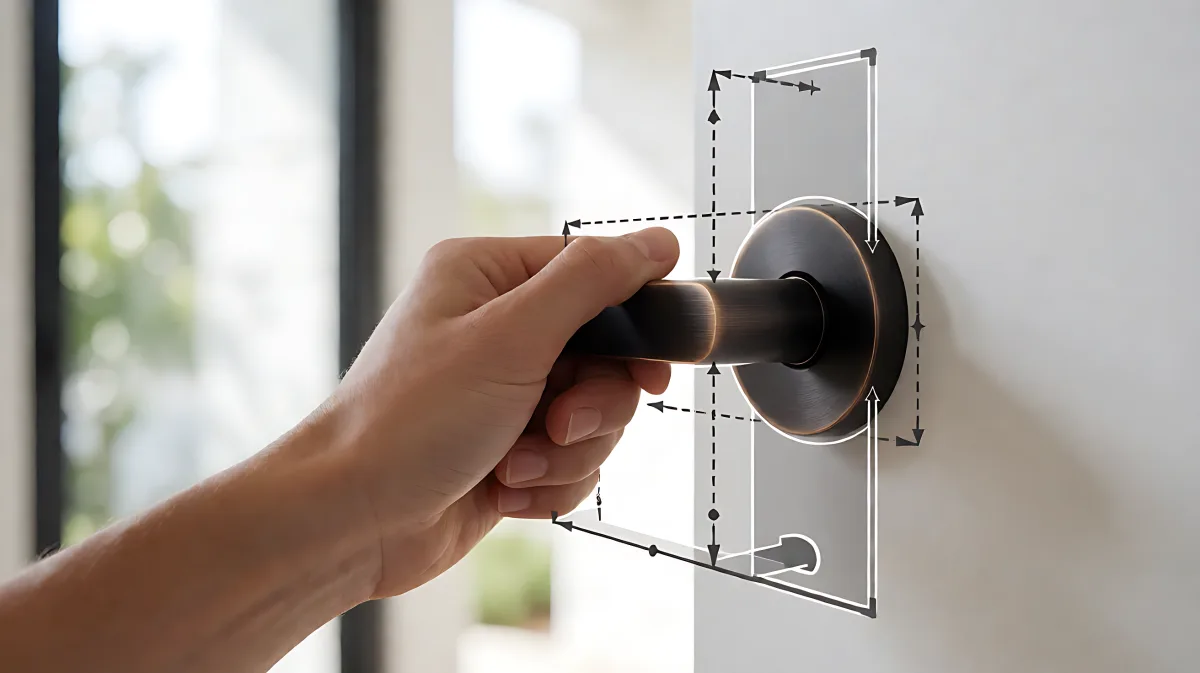
Door handles are not just hardware; they are biomechanical interfaces. This guide explains how friction, torque, and grip force influence safety, and provides precise measurement standards for seamless operation in modern homes.
Door handle friction biomechanics refer to the study of how the force required to operate a lock mechanism affects hand safety, joint stress, and overall ease of use. According to 2026 safety guidelines from the National Fire Protection Association, smooth operation reduces fall risk for elderly users by minimising the grip strength needed to open exits.
Why Biomechanical Friction Matters in Home Safety
When you pull a handle, you are engaging a complex system of levers, springs, and tumblers. The resistance you feel is friction between these internal parts and the surface of the handle against your palm. For individuals with arthritis or reduced mobility, excessive friction can be a significant barrier. The Biomechanics and Kinesiology Society highlights that high resistance moments can lead to micro-injuries in the wrist and forearm over time. In 2026, modern hardware design prioritises low-friction materials and balanced spring tension to ensure that the torque required to unlock a door remains below 15 newton-metres, a threshold that keeps the experience comfortable for all demographics.
How Do Lever Handles Outperform Knobs in Friction Management?
Knobs require a rotational movement that applies torque to a central shaft, demanding significant force to overcome static friction. Levers, however, use a linear push-down motion. This design reduces the necessary grip force by up to 40 percent. The lever arm acts as a force multiplier, allowing the user to use their body weight rather than just finger strength. In the US and UK, lever handles are now preferred in public buildings and for elderly care facilities due to their superior biomechanical profile. A properly adjusted lever should feel weightless yet firm, with a spring return that does not require extra pulling force.
What Are the Critical Sizing Measurements for Optimal Function?
Fit is the primary determinant of friction. If the handle does not align perfectly with the lock, the user must exert extra force to overcome the misalignment. This is where precise measurements are vital. The most critical metric is the PZ size, which is the distance from the centre of the spindle to the centre of the keyhole. In the UK, 92mm and 62mm are the most common PZ dimensions for uPVC doors. In the US, the standard backset is typically 2 3/8 inches. Screw centres also dictate stability; a standard 4-inch or 8.5-inch backplate length ensures the handle is anchored securely to the door without flexing. Flexing increases dynamic friction and wears out the internal spring cassette quickly.
How Does Misalignment Affect Friction and Safety?
If the handle feels 'floppy' or does not return to its resting position, it is usually a sign of spring failure or spindle wear. A worn spindle creates a gap between the handle and the plate, leading to rattle and increased wear. This mechanical play increases the friction the user feels at the moment of locking. The Door Hardware Association warns that a misaligned multipoint lock can jam, making it difficult to release the door during an emergency. To check alignment, close the door and attempt to lift the handle. If the handle binds or requires significant effort to move, the hinges may be dropping, causing the locking points to sit against the strike plate rather than inside it.
What Is the Role of the Spindle and Grub Screw in Reducing Friction?
The spindle is the square rod that connects the inside and outside handles. It must fit tightly into the gearbox. A loose fit allows the handle to wobble, creating friction at the contact points. Most modern handles feature a small grub screw on the underside of the backplate. Tightening this screw (by roughly 1/16th of a turn) ensures the handle is clamped firmly to the spindle. If the spindle is rounded or worn, the friction cannot be fixed by tightening; the part must be replaced. A smooth, high-precision spindle reduces the coefficient of friction between the moving parts and the housing.
How Do You Diagnose and Fix Excessive Handle Resistance?
Start by loosening the fixing screws on the inside handle. Check if the handle is straight. If it is cocked or angled, the spindle may be bent. Next, test the spring action. A healthy spring cassette should return the lever to a 15-degree angle automatically. If the handle hangs low or is too high, the spring is likely broken. In 2026, most hardware stores sell replacement spring cassettes separately, but replacing the entire handle set is often more cost-effective. Ensure that you match the handedness of the handle; while most are reversible, some older models are left- or right-specific.
Does Wear Affect the Longevity of the Hardware?
Yes. Over time, the internal tumblers and springs fatigue. This fatigue manifests as 'creak' or 'grind' when the handle is turned. The friction coefficient of steel-on-steel components increases as metal shavings accumulate. Regular lubrication with a dry PTFE spray can reduce this noise and extend the life of the mechanism. Avoid using WD-40, which is a solvent that can wash away existing lubricants and attract dust. The American National Standards Institute recommends that all door hardware in high-traffic areas be serviced every 12 months to maintain optimal friction levels.
What Are the Biomechanical Risks of Poorly Chosen Handles?
For seniors, a stiff handle can lead to slips if they drop their grip due to sudden resistance. A 'click' or 'slip' of the handle from the palm can cause a loss of balance. This is why the surface finish matters. A brushed or satin finish provides a better grip than a high-gloss polish, reducing the friction between the skin and the metal. The handle diameter should also be considered; a diameter between 40mm and 50mm is the biomechanical sweet spot for the average adult hand. Handles that are too thin force the user to grip more tightly, increasing the risk of carpal tunnel syndrome over years of use.
How Do You Choose Between a Lever and a Knob for a Specific User?
If the user has limited hand strength, a lever is always the superior choice. It leverages the weight of the forearm to turn the lock. Knobs rely on the finger and thumb, which are smaller and weaker muscles. For children, however, a knob with a smaller diameter may be easier to grasp. In a mixed-ability household, a lever handle is the most inclusive choice. It is also faster to operate in an emergency, reducing the time spent at the door during a fire or other crisis. The fast action of a lever is a key safety feature in 2026 building codes for accessible housing.
FAQ
Why does my door handle feel loose even after tightening the screws?
If the handle still wobbles, the square spindle inside the door may be worn or rounded. In this case, tightening the screws will not fix the issue because the metal is no longer making a firm contact with the square hole. You will need to remove the handle and replace the spindle with a new one, ensuring it is the correct length and width.
What is the standard PZ size for most modern UK uPVC doors?
The two most common PZ sizes are 92mm and 62mm. The 92mm PZ is typically found on doors with a 62mm backset, while 62mm PZ is used for 30mm backsets. It is essential to measure from the centre of the square hole to the centre of the keyhole to ensure the new handle aligns with the existing lock.
Can a door handle friction issue cause a lock to jam?
Yes. If the handle has excessive 'play' due to a worn spindle or spring, the internal mechanism can shift out of alignment. This can cause the latch to fail to retract fully, making it feel like the lock is jammed. Properly maintaining the spring tension and spindle integrity prevents this misalignment.