Voice-Activated Lighting for Dementia: Simple Nighttime Safety Tips
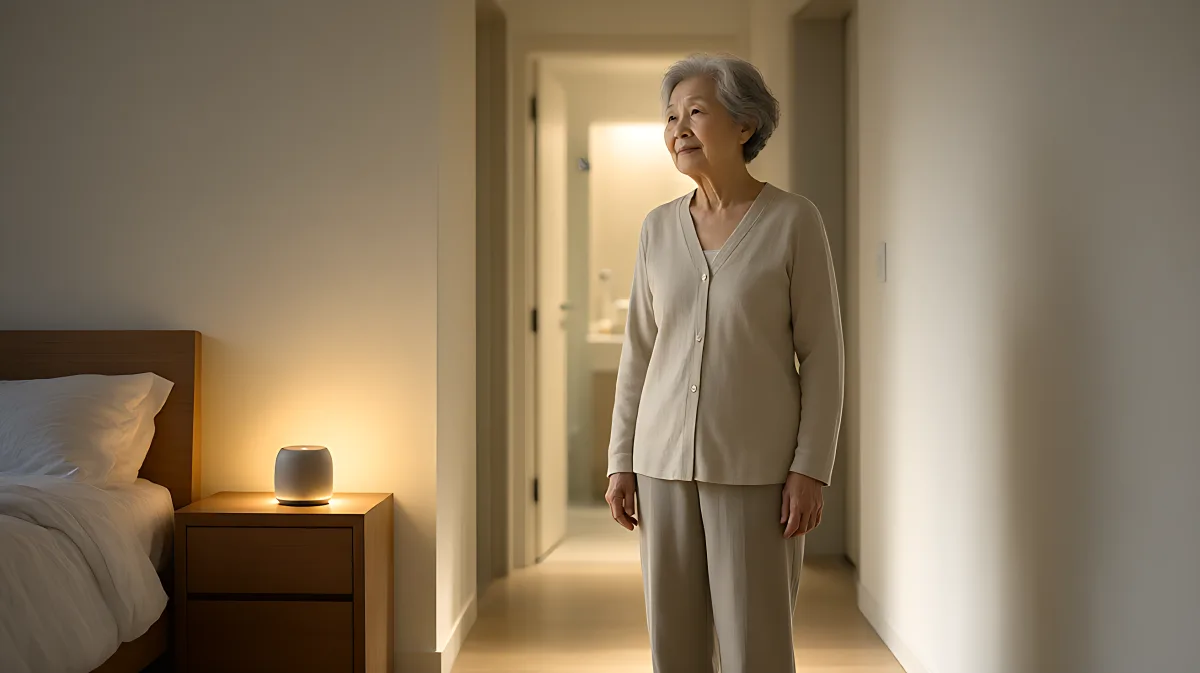
Voice-activated smart lighting lets adults with early-stage dementia turn on hallway and bathroom lights without searching for switches. This hands-free approach lowers the risk of disorientation, falls, and frustration during 2 a.m. bathroom trips.
Before adopting voice-activated lighting, many adults with early-stage dementia spend disorienting minutes in the dark, fumbling for wall switches while confused and frightened. After installing a simple smart speaker system linked to smart bulbs, the same individual simply says a short phrase, and the hallway and bathroom lights gently illuminate within seconds. This hands-free solution removes the need to memorize complex commands or navigate unfamiliar interfaces, directly reducing nighttime stress and the risk of falls on unlit steps.
Why traditional light switches fail dementia patients at night
For someone with early-stage dementia, the cognitive load of locating a specific wall switch in a dim room can be overwhelming. The Alzheimer's Association notes that as the disease progresses, individuals often lose the ability to recognize where they placed objects or how to perform familiar tasks like turning on a light switch. In the middle of the night, when sleep inertia and memory loss collide, this simple act becomes a source of significant anxiety. Many families assume that installing motion-sensor lights is a complete fix, but in fact, motion sensors can trigger unpredictably at the wrong times or fail to activate if the person is moving slowly. Voice control offers a direct, intent-based solution: the light turns on only when the person specifically asks for it.
How voice activation works without complex commands
The goal for adults with early-stage dementia is not to create a new set of memorized codes, but to leverage the brain's strong retention of routine phrases. A smart speaker like an Amazon Echo or Google Nest Hub can be paired with smart bulbs in the bedroom, hallway, and bathroom. To make this usable, you set up a single, specific wake word and phrase—such as saying "Hey Echo, turn on the hallway light." The device listens for that exact phrase. Because early-stage dementia patients retain procedural memory (the muscle memory of doing things) much longer than semantic memory (facts about the world), practicing this specific phrase during the day makes it more likely to come to mind when they get up at night.
Does this actually replace medical alert devices?
No. It is a common misconception that smart lighting can act as a standalone emergency response system. Smart speakers are not designed to monitor vitals or detect falls automatically in the way a dedicated medical alert watch does. According to the CDC, over 500,000 older adults visit the emergency department for injuries caused by falls, and lighting is just one environmental factor in fall prevention. Voice-activated lighting is a comfort and orientation tool, not a medical monitoring device.
The before-and-after impact on independence
The difference in quality of life is measurable in fewer nighttime disturbances and less caregiver wake-ups. Before the change, a person might lie in bed for twenty minutes, feeling lost and scared because they cannot find the switch to go to the bathroom. After the change, they can call for the light with one spoken phrase, navigate the illuminated path safely, and return to bed. This specific shift from "helpless confusion" to "guided independence" preserves the individual's sense of dignity. It also significantly reduces the cognitive burden on the caregiver, who no longer has to physically rush to the room every time the bed creaks.
Step-by-step checklist for setting up hands-free lighting
- Identify the critical path: Map out the three to four rooms a person will use at night (bedroom, hallway, bathroom, living room).
- Choose accessible bulbs: Buy smart LED bulbs that fit existing sockets. Do not rely on switch-controlled smart plugs that require a physical flip.
- Select a single smart speaker: Place one device on the nightstand, within arm's reach of the pillow. Do not scatter multiple speakers, as this creates confusion about where to speak.
- Create a custom, short phrase: Avoid long instructions. Use a short, three-to-five-word command like "Light on" or "Hallway light."
- Set the brightness low: Program the lights to default to a soft, 20% brightness level for nighttime use. Bright, full-intensity lights can disorient a person with dementia who is half-asleep.
- Rehearse the routine: Practice turning on the lights using the voice command five times during the day. This builds the muscle memory needed for a nighttime emergency.
Comparing smart lighting to other in-home safety tech
When choosing a solution for nighttime disorientation, it helps to understand how different technologies stack up. Voice lighting is about orientation, whereas other tools are about tracking or alerts.
| Feature | Voice-Activated Lighting | Motion-Sensor Lights | Location Trackers (GPS) |
|---|---|---|---|
| Primary Function | Illuminates specific path on command | Illuminates automatically upon movement | Locates person if they wander outside |
| User Effort | Must speak a specific phrase | None (passive) | Wears a tag or watch |
| False Triggers | Very low (requires intent) | High (can light up for pets or shadows) | N/A |
| Best For | Getting up for bathroom at night | Sensor lighting in hallways | Preventing outdoor wandering |
This comparison highlights that while GPS trackers and motion sensors have their place, voice lighting is the most precise tool for the specific problem of getting out of bed and navigating a dark house. It does not light up the whole house or rely on the person accidentally walking past a sensor.
According to Dementia Care Central, assistive technology for dementia should focus on maintaining the person's independence rather than restricting it. Voice lighting supports this by giving the user direct control over their environment. They are not being woken up by a motion sensor; they are actively calling for the light they need. This active participation helps maintain a sense of agency even as the disease progresses.
It is also worth noting that these devices integrate with other monitoring tools. For example, a wearable like a medical alert watch that detects a fall might alert a caregiver, but the smart lighting can simultaneously turn on the hallway lights, providing immediate visual confirmation that the person is moving toward the door or bathroom. This synergy between visual cues and auditory alerts creates a much safer environment than relying on one technology in isolation.
Common mistakes to avoid when buying smart speakers
Many families assume that any smart speaker will work seamlessly with any smart bulb. In fact, they must be on the same Wi-Fi network and use compatible protocols (like Zigbee or Wi-Fi). Buying a Wi-Fi bulb for a house with a weak signal in the bedroom is a common error. The speaker will not receive the command to turn on the light if the signal drops out in that specific location.
Another frequent error is failing to disable the standard physical wall switches. If the smart bulb is still controlled by the original switch, the person can accidentally kill the power to the light when they reach for the switch in the dark. This disconnects the smart bulb from the network, meaning the voice command will stop working until the power is manually restored.
A practical workaround is to leave the wall switch in the "on" position permanently and use the voice command for all lighting needs. Alternatively, you can purchase a smart plug and hardwire the bulb to a separate circuit, but this is more complex and often unnecessary for a simple hallway setup.
Finally, do not overlook the cost of subscription services. While the bulbs and the speaker are a one-time purchase, some monitoring and alerting features require a monthly fee. However, the core lighting function is free. According to Lifeline, smart speakers are not a substitute for dedicated emergency systems. They are great for lights, music, and reminders, but you need a separate medical alert system for actual emergencies like a fall where the person is unconscious and cannot speak.
This article is for general information only and is not a substitute for professional medical advice, diagnosis, or treatment. Always consult a qualified clinician about your situation.
Frequently Asked Questions
Can a person with advanced dementia still use voice-activated lights?
Generally, no. Voice activation relies on the user's ability to understand a concept, retain a phrase in memory, and execute it intentionally. As dementia advances to the middle or late stages, the ability to use a voice command for a specific task often disappears. At this stage, motion-sensor lights or automated schedules are usually more reliable, as they do not require the user to initiate the action.
What is the best wake phrase for a smart speaker for dementia?
Keep it as short and routine-based as possible. Phrases like "Echo, light on" are better than "Echo, turn on the light in the hallway." The shorter the command, the easier it is to access during a moment of cognitive confusion. Use the device's default wake word and a simple, direct action word.
Does voice-activated lighting work if the power goes out?
No. Smart speakers and Wi-Fi bulbs require power and internet connectivity. If your home loses power, the lights will not turn on. To mitigate this risk, place a standard, manual flashlight on the nightstand as a backup. You can also invest in a smart speaker with a built-in battery, but it will only work for a limited time.
Is it safe to leave a smart speaker on 24/7?
Yes, it is safe to leave the device on, but privacy is a consideration. Smart speakers are designed to listen for a specific wake word 24/7. Most devices do not constantly record or send audio to the cloud; they only process data when the wake word is detected. However, it is a good practice to unplug the device or use a cover if you have specific privacy concerns or if a family member is not comfortable with the idea.