Organization vs. Organisation: Spelling Guide and Management Tips
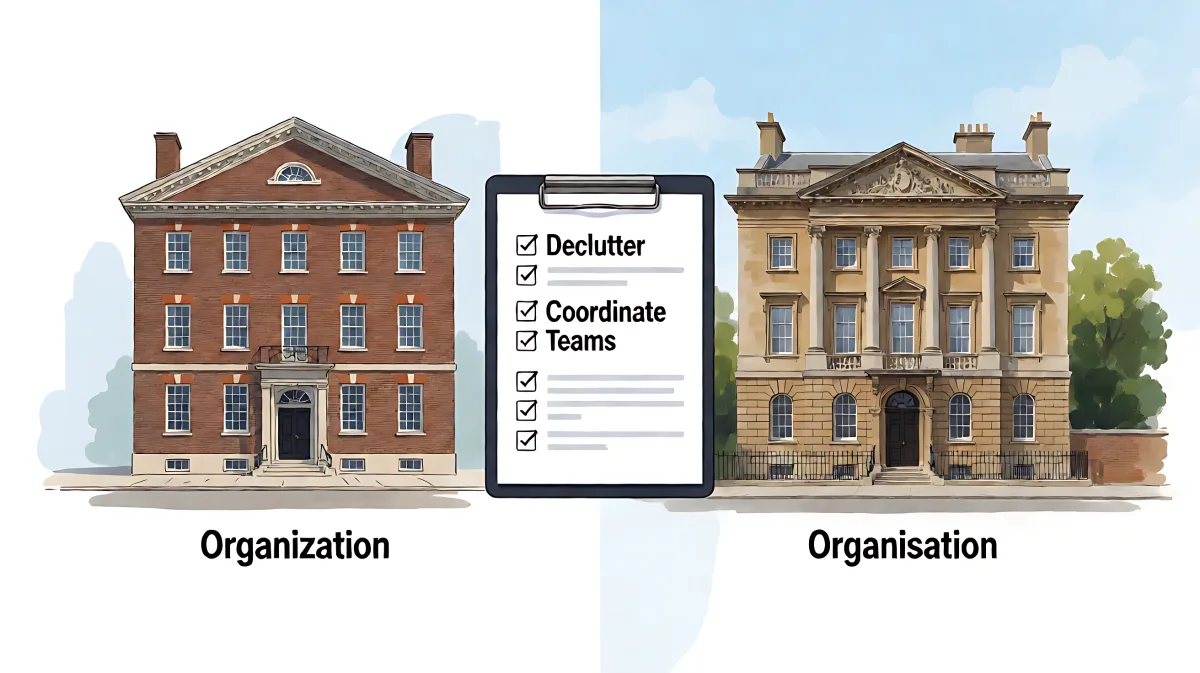
Confused about whether to use 'organization' or 'organisation'? This guide clarifies regional spelling differences and provides a practical framework for managing personal and professional structures efficiently.
Use organization for American English contexts and organisation for British and Commonwealth audiences. While both terms refer to a group of people with a common purpose or a state of being neatly arranged, spelling varies significantly by region. Mastering this distinction ensures your writing aligns with local publishing standards and reader expectations effectively.
Why Do Two Spellings Exist?
The divergence between these two terms stems from historical linguistic shifts. When American settlers began to form a distinct cultural identity, they deliberately altered certain words to differentiate themselves from the UK. Early American editors often replaced the letter 's' with 'z' in words of Greek origin, such as organize, to create a more phonetic spelling that matched how Americans pronounced the word. In contrast, British English retained the older, Latin-influenced 's' spelling.
According to linguistic usage data tracked by writing editors, while American English standardized around the 'z' spelling decades ago, British English continues to use both forms. However, the 'z' version is increasingly common in UK publications, suggesting a gradual convergence over time. Regardless of your location, consistency is key. If you are writing for a US audience, use organization. If you are writing for a UK, Australian, or Canadian audience, organisation is the safer, more traditional choice, though many UK style guides now accept the 'z' variant.
How Do I Choose the Right Spelling for My Audience?
Consider the primary location of your readers. For US-based content, always use organization. For UK or Commonwealth content, organisation is preferred by most major newspapers and academic institutions. A useful mnemonic is to associate the 's' spelling with UK cities that start with S, such as Salisbury, Sheffield, and Sandwich. If you are unsure, defaulting to organization is generally safe because it is widely accepted in both regions, but you should always check your specific style guide for consistency.
What Does Effective Organization Management Look Like?
Beyond spelling, the concept of an organization extends to how groups and spaces are managed. Effective organization management is the bridge between a group's ambition and its actual performance. It involves aligning diverse individuals behind a shared purpose, optimizing resource use, and providing clear direction to employees. Without this management layer, even the most talented teams will struggle to meet deadlines or maintain quality.
Many families and small businesses assume that organization is simply about putting things away or keeping a tidy appearance. But in fact, organization is a system for managing time, space, information, and people. It is about reducing friction and freeing up mental capacity. A well-organized workplace does not just look neat; it allows teams to coordinate across departments without silos and duplication of effort.
Key Features of a Well-Run Organization
- Clear Roles: Every member knows their responsibilities and how they contribute to the larger goal.
- Cross-Departmental Coordination: Teams collaborate seamlessly rather than working in isolation.
- Resource Efficiency: Planning ensures that time and money are deployed where they create the most value.
- Employee Engagement: A positive culture fosters loyalty, reducing turnover and increasing productivity.
How Can I Organize My Personal Work Life?
Applying organizational principles to personal productivity requires a shift in mindset. Instead of focusing on tidiness for the sake of aesthetics, focus on systems that save time. The core process involves four main areas: time, space, information, and people. Most beginners struggle because they try to fix all four simultaneously, leading to overwhelm.
Start with space. The first and most critical step is decluttering. Remove items that are broken, expired, or no longer serve a purpose. As noted by productivity experts, holding onto sentimental or rarely used items consumes valuable storage and mental energy. For example, storing a cookie press in a frequently used cooking drawer because it fits physically is a common error. Instead, store items near where they are used to reduce friction in daily routines.
Once you have decluttered, give every remaining item a specific home. Resist the urge to buy decorative bins before you have a plan. Measure your space and choose containers that fit logically. This approach transforms your workspace from a cluttered collection of objects into a functional system that supports your workflow.
Actionable Steps to Build a Better System
- Identify One Area: Choose a single space (like a desk or inbox) to organize first to avoid burnout.
- Declutter Aggressively: Remove anything you haven't used in over a year or that is broken.
- Map Usage Zones: Keep items used daily within arm's reach and rarely used items in secondary storage.
- Implement a Review Habit: Spend 10 minutes each week resetting your space to prevent future clutter.
- Digitize Information: Scan or file physical documents to reduce physical storage needs.
Common Mistakes to Avoid in Organization
One frequent misconception is that organization is a one-time event. Many professionals assume that once a closet or office is tidied, it will stay that way. However, organization is a continuous habit. Without regular maintenance, systems collapse within weeks. To correct this, build small, sustainable routines rather than attempting a massive overhaul every year.
Another error is prioritizing appearance over function. A beautiful storage solution that is hard to access will defeat the purpose of organization. Functionality must always come before aesthetics. If a system requires extra effort to use, you will likely abandon it in favor of returning to the convenient but chaotic status quo.
FAQs
Is organization or organisation more professional?
Neither is more professional; it depends on your audience. In the US, organization is the standard. In the UK, organisation is traditional, but organization is increasingly accepted. Consistency within your document is what matters most to editors and readers.
How do I start organizing a cluttered home?
Begin with a small, manageable area like a single drawer or the top of a dresser. Use the 'joy' or 'utility' test to decide what stays. Remove items that are broken or unused, then assign a specific home to the remaining items based on frequency of use.
What is the difference between organization and management?
Organization refers to the structure or arrangement of elements. Management is the active process of directing resources and people to achieve goals within that structure. You need a clear organization (structure) to implement effective management (process).