Knee Injections: Steroids vs. Hyaluronic Acid Evidence
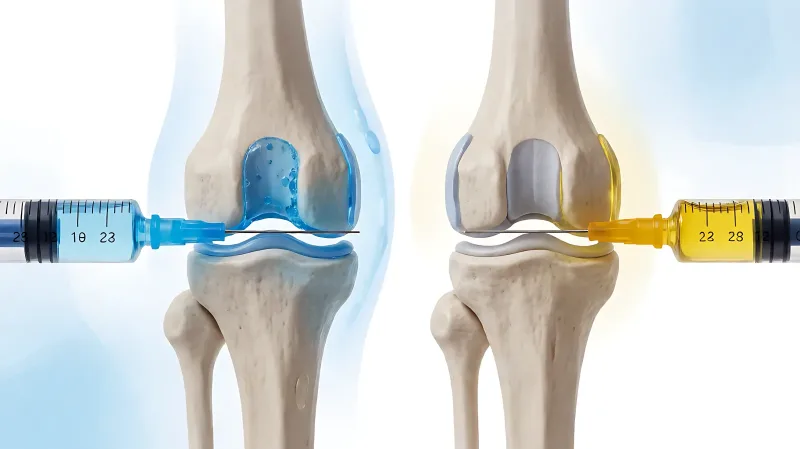
Discover what recent medical data reveals about the structural impact of steroid versus hyaluronic acid injections on knee joints. Learn which treatment is safer for long-term cartilage health.
A recent study from the Osteoarthritis Initiative found that corticosteroid injections for knee osteoarthritis were associated with increased structural joint damage over two years, whereas hyaluronic acid injections were linked to slower disease progression. This emerging evidence suggests that while both options provide pain relief, hyaluronic acid may offer better long-term joint safety compared to repeated steroid use.
For more information, see MedlinePlus medical encyclopedia from the National Library of Medicine.
What Is the Difference Between Steroid and Hyaluronic Acid Injections?
Doctors commonly use two types of intra-articular injections to manage knee osteoarthritis. Corticosteroid injections contain anti-inflammatory drugs that quickly reduce swelling and pain. Hyaluronic acid injections, often called viscosupplementation or gel shots, work by adding lubrication to the joint to mimic the natural fluid lost during the disease process. Steroids are fast-acting, while hyaluronic acid aims to restore the mechanical environment of the joint.
The human body naturally produces hyaluronic acid to keep joints moving smoothly. As osteoarthritis progresses, this natural production declines, leading to friction and stiffness. In clinical practice, hyaluronic acid treatments are frequently used for patients who have moderate knee pain, especially those who do not respond well to oral pain medications or who wish to delay or avoid total knee replacement surgery.
What Does New Evidence Say About Joint Damage?
Research published in Radiology in May 2025 challenged the routine use of corticosteroids for knee arthritis. The study analyzed data from 210 participants in the Osteoarthritis Initiative, a longitudinal study sponsored by the National Institutes of Health. Researchers focused on a subset of 70 participants who received a single injection: 44 received corticosteroids and 26 received hyaluronic acid. These groups were compared to a control group of 140 patients who received no injections.
Using advanced MRI scoring systems, the study found that patients who received corticosteroid injections experienced significantly greater structural damage to the knee joint over the following two years. This included accelerated wear to the cartilage and changes to the subchondral bone. In contrast, the hyaluronic acid group showed decreased progression of joint damage. In fact, some patients in the hyaluronic acid group appeared to have stable or even improved cartilage structure compared to their baseline scans.
How Effective Is Hyaluronic Acid for Pain Relief?
Both injection types provided pain relief in the short term. However, the safety profile differed significantly. Corticosteroids are known to inhibit matrix synthesis and impair the repair mechanisms of cartilage. While this is useful for acute inflammation, repeated use may weaken the joint structure over time. Hyaluronic acid does not have these anti-inflammatory properties but instead supports the joint's natural cushioning.
For patients with mild to moderate osteoarthritis who are not yet surgical candidates, the data suggests that hyaluronic acid is a preferable option. The treatment is typically administered as a series of three shots, one per week. The effects can last for up to six months, after which the series may be repeated. Because the treatment is localized to the knee, systemic side effects are rare.
What Is the Procedure for Knee Injections?
The injection process is a straightforward outpatient procedure. The area is cleaned and numbed with a local anesthetic. Doctors often use ultrasound guidance to ensure the needle is placed precisely within the joint space. Patients are advised to avoid heavy weight-bearing activities on that leg for a few days following the injection. You can generally resume normal daily activities after this short rest period.
| Treatment Type | Primary Mechanism | Typical Duration | Long-Term Safety |
|---|---|---|---|
| Corticosteroid | Anti-inflammatory | 2 to 6 months | Associated with accelerated cartilage loss |
| Hyaluronic Acid | Lubricant / Viscosupplement | 6 to 12 months | Neutral to beneficial for joint structure |
Who Should Consider These Injections?
Patients should discuss their specific symptoms with a healthcare provider. Hyaluronic acid injections are particularly suitable for individuals who have moderate knee pain, have failed conservative therapies like physical therapy or weight loss, and wish to avoid surgery. The American Academy of Orthopaedic Surgeons and other bodies have noted that these injections can be a valuable bridge for those managing chronic knee issues.
What Are the Risks of Steroid Injections?
While effective for pain, the evidence suggests that corticosteroids may accelerate the underlying disease. Beyond cartilage wear, there is a noted risk of subchondral bone changes and an increased susceptibility to insufficiency fractures. The Centers for Disease Control and Prevention emphasizes the importance of sterile technique to prevent infection, a risk present in any joint injection. Given the new data, many clinicians are now more cautious about using steroids as a first-line treatment for mild to moderate cases.
How Long Do Hyaluronic Acid Results Last?
The relief provided by hyaluronic acid injections typically lasts between six and twelve months. Some patients find the effect extends up to a year. This duration makes it a manageable option for chronic condition management. Because it is a biological substance, the body eventually absorbs it, requiring periodic retreatment for continued benefits. The procedure is considered safe for most adults, with the main risks being temporary localized pain or swelling at the injection site.
Frequently Asked Questions
Is hyaluronic acid safer than steroids for knees?
Recent data indicates that hyaluronic acid is structurally safer. Corticosteroid injections have been linked to faster cartilage deterioration over two years, while hyaluronic acid injections showed no such decline and may help maintain joint integrity.
How many hyaluronic acid shots are needed?
The standard protocol usually involves a series of three injections, given one week apart. Some protocols involve fewer shots, but the three-week course is common to ensure adequate lubrication buildup.
Do these injections stop osteoarthritis?
No, neither injection cures osteoarthritis. They are palliative treatments designed to reduce pain and improve function. Hyaluronic acid may slow structural progression, but it does not regenerate lost cartilage tissue.
Can I get both injections?
Generally, these injections are used as alternatives rather than in combination. A doctor will choose one based on your pain level and imaging results. Mixing them is not a standard practice.
Who should not get these injections?
People with an active infection in the joint, severe skin infection at the injection site, or severe bleeding disorders should avoid intra-articular injections. Always consult a specialist before proceeding.