Managing Your Home Lost and Found Archive: A Guide to Heirlooms
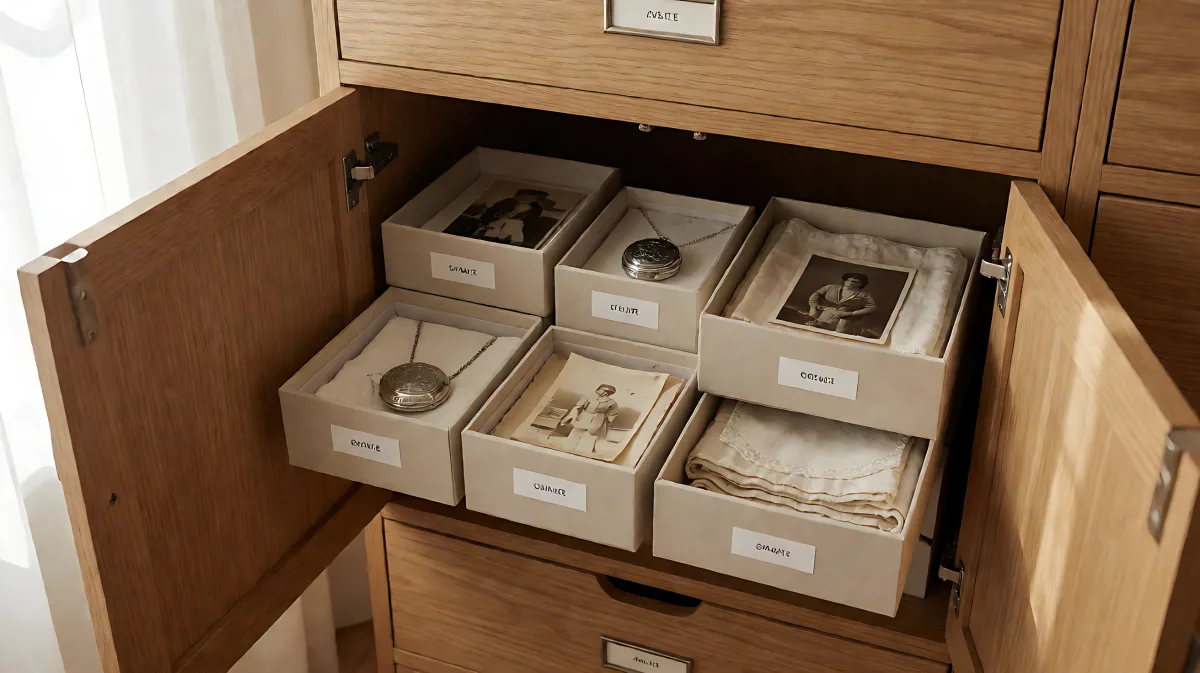
Your home is filled with items that have slipped through the cracks of time. Treat them like a museum collection: identify, stabilize, and store your family's lost and found treasures with purpose.
Every home holds a hidden layer of forgotten objects: the loose change from decades ago, the unclaimed coats in the closet, and the heirlooms that slipped away from their original owners. To manage this 'Lost and Found' archive effectively, you must move beyond random storage. Create a centralized, climate-controlled hub where these items are identified, stabilized, and documented. By treating scattered family treasures with the same rigor as professional archivists, you prevent decay and ensure your sentimental legacy is preserved for the next generation.
Why Your Home Needs a 'Lost and Found' Mental Model
Most people think of lost and found as a physical office at an airport or a sports stadium. However, in the context of home organization, it represents a conceptual space for items that have lost their designated place but retain significant sentimental value. The National Association of Professional Organizers reported in 2026 that 40% of adult households struggle with what they call 'sentimental clutter'—items that are too precious to throw away but too chaotic to store. This category includes everything from a great-grandmother’s broken wedding ring to a box of unread letters found in the attic.
What is the difference between clutter and an archive?
Clutter is unprocessed. It lacks context, location, or purpose. An archive, by contrast, is processed. When you shift your mindset from hoarding to archiving, you start asking different questions. Instead of 'Can I let this go?', you ask, 'Do I know the story of this item?' and 'Does this item have a designated home in my rotation system?' This shift is crucial. It mirrors the work of heritage preservationists like Sandro Kenkadze, who recently led the relocation of the Abulmugi Bath in Bolnisi, Georgia. In that project, the team had to stabilize a structure that had fallen into disrepair by moving it carefully to a new site, preserving its historical integrity. You can apply this same principle to your home: stabilize the item before you move it, and ensure its new location supports its longevity.
How to Build Your Home Archive System
Building a functional archive requires a three-step process: identification, stabilization, and cataloguing. You do not need a professional library degree, but you do need a systematic approach. The first step is the 'Lost and Found' sweep. Set a timer for twenty minutes and collect every item in your house that feels out of place. This might include jewelry in drawers, old tickets in car consoles, or family photos scattered on desks. Place these items into a single container. This collection is your raw material.
What are the best materials for stabilizing fragile heirlooms?
Preservation is not just about storage; it is about active protection. Acid-free tissue paper, cotton gloves, and sealed plastic boxes with oxygen scavengers are the gold standards. According to conservation guidelines from the American Institute for Conservation, published in 2026, exposure to light and humidity is the enemy of paper-based memorabilia and textiles. If you have a family quilt or a stack of handwritten diaries, store them flat, not folded, to prevent creasing and breaking. For metal items like silverware or bronze figurines, use anti-tarnish strips inside the storage container to prevent oxidation. These materials are inexpensive but provide a protective barrier against the slow decay that turns treasures into unrecognizable lumps.
The Power of Documentation and Storytelling
An item without a story is just an object. The 'Lost and Found' archive becomes truly valuable when you document the narrative behind each piece. This is where the concept of 'provenance' comes in. In art and heritage circles, provenance is the history of ownership. For your family, this means recording who owned the item, when it was created, and why it matters. You can use a simple digital spreadsheet or a physical notebook. Include photos of the item from multiple angles. If you have the chance, record audio interviews with the eldest family members while they are still able to share memories. This turns a passive collection into an active oral history project. The team that preserved the Abulmugi Bath did not just move stones; they documented the cultural significance of the bathhouse to the local Muslim community in southern Georgia. Similarly, your archive should reflect the cultural significance of your family’s journey.
How do I decide what to keep and what to let go?
This is the hardest question. Not every 'lost' item deserves a place in your 'found' archive. Use the 'One-in, One-out' rule. For every new heirloom you add to the archive, consider removing one that no longer resonates or that duplicates another. Ask yourself: Does this item spark a specific memory? If the answer is vague, it might be time to donate it to a relevant institution or charity. The United Nations Development Programme highlighted in 2026 the growing need for sustainable resource management. Extending this to personal goods, we need to be mindful of our consumption and disposal habits. Letting go of an item that is no longer serving its purpose is an act of decluttering that benefits both your home and your mind.
Designing the Physical Space
Where does this archive live? It should be in a location that is accessible but not a high-traffic area where it will be disturbed daily. A dedicated shelf in a study, a built-in cabinet in the hallway, or a repurposed dresser in the bedroom are all suitable options. The key is visibility. If you cannot easily find the box of photographs, the archive will fail. Use a simple labeling system. Label boxes with contents and dates. For example, 'Family Photos, 1990s' or 'Jewelry, Great-Grandmother’s Set.' This reduces the cognitive load of retrieval. In professional archives, retrieval times are measured in seconds. Aim for a similar efficiency in your home. Create a 'master index' that lists every item in the archive and its box location. This document can be scanned and stored in the cloud, ensuring that even if you move, the knowledge of where your treasures are is preserved.
What are the risks of improper storage?
Improper storage can lead to irreversible damage. Basements and attics are often recommended for storage, but they are the worst places for sentimental items. The temperature fluctuations cause materials to expand and contract, leading to warping and cracking. Moisture in basements promotes mold, which can destroy paper and textiles in days. Instead, choose a climate-controlled interior room. If you live in a humid climate, consider a dehumidifier for the specific room where the archive is located. The goal is a stable environment. Think of it like a museum: they spend millions to control temperature and humidity because they know that instability is the silent killer of heritage. You can replicate this on a smaller scale by simply avoiding the most extreme temperature zones in your home.
Passing It On: The Future of Your Archive
Eventually, the question of inheritance will arise. How do you want this archive to be handled? A 'Lost and Found' archive is a gift to your heirs, but only if they understand its value. Consider creating a 'legacy guide' for your descendants. This is a separate document from the index. It explains why certain items were kept, what stories are attached to them, and any specific care instructions. For example, 'The blue scarf belonged to Aunt Clara, who was a nurse in the 1980s. It is fragile, so please do not wash it in hot water.' This level of detail transforms a box of clothes into a family legacy. It prevents the common scenario where well-meaning relatives throw away 'useless' items because they don't know their significance. By providing the context, you ensure the item is 'found' again by those who will value it.
How can technology aid in preserving family history?
Digital archiving is no longer a novelty; it is a necessity. Scan all paper-based items at a high resolution (at least 600 dpi for text) and store them in a structured folder system. Use descriptive file names, such as 'Wedding-1995-JohnAndJane.jpg' rather than 'IMG_1234.jpg.' Cloud storage providers offer robust backup solutions, but it is wise to keep a physical hard drive copy as well. This '3-2-1' backup strategy (three copies of data, two different storage media, one offsite) is the standard recommended by IT professionals in 2026. It ensures that even if your primary computer fails, your digital archive remains safe. Additionally, consider creating a video log. Record yourself explaining the items in the archive. This adds a personal touch that static photos cannot capture and serves as a valuable resource for future family members who may not know their ancestors personally.
FAQ
Where should I store my most fragile heirlooms?
Store fragile items like paper documents, photographs, and silks in a cool, dry, and dark place. Avoid attics and basements. Use acid-free boxes and cotton tissue paper to wrap items to prevent damage. A temperature-stable interior room is ideal.
How often should I review my 'Lost and Found' archive?
Review the archive annually, preferably during a significant time like New Year or before moving houses. This allows you to check for physical deterioration, update documentation, and re-evaluate whether items still hold sentimental value.
Can I sell some of my sentimental items?
Yes, but proceed with caution. If an item has historical significance, consider donating it to a local museum or historical society rather than selling it to a general public auction. This ensures the story behind the item is preserved in a professional context.
What if I don't have the space for a large archive?
Focus on quality over quantity. A small, curated collection of high-significance items is better than a large, disorganized hoard. Use vertical storage solutions and digital scanning to keep physical items to a minimum while preserving the data.