Caffeine Half-Life and Sleep Latency: The 8-Hour Rule
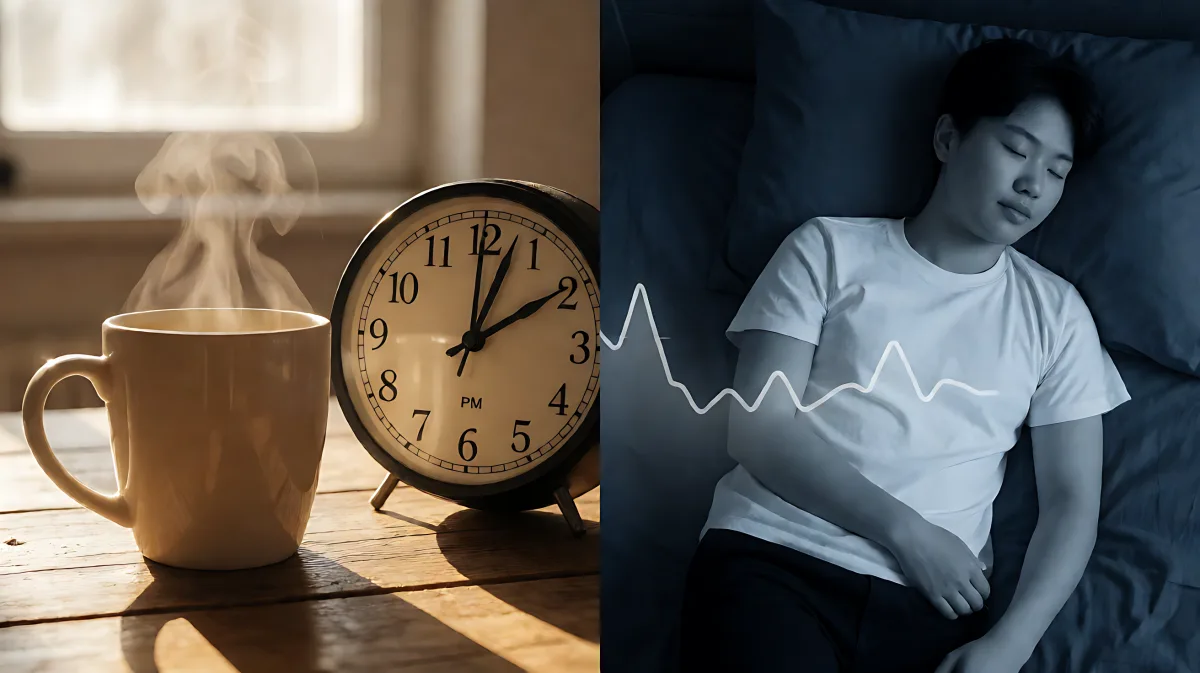
Thinking you sleep fine after a late coffee? New data suggests objective sleep measures contradict subjective feelings. Understand the half-life range and genetic factors.
Caffeine does not just keep you awake; it actively erodes the quality of your rest long after you stop feeling alert. A pooled analysis of recent randomized controlled trials found that caffeine intake reduces total sleep time by approximately 35 minutes and delays the onset of sleep by over eight minutes. Because individual metabolism varies drastically due to genetics, there is no single universal cutoff time, but experts generally recommend avoiding caffeine at least eight to ten hours before your intended bedtime to protect sleep architecture.
Why Your Subjective Feelings Are Lying About Sleep Quality
Many coffee drinkers assume that if they fall asleep on time, their sleep is not affected. In fact, this is one of the most common misconceptions in sleep hygiene. Research from the Henry Ford Hospital Sleep Disorders Center demonstrated that participants who consumed caffeine six hours before bed lost over an hour of total sleep time and experienced significant reductions in deep sleep. Despite these objective markers of poor sleep, the participants reported that they felt they slept well. This gap between perceived and actual sleep means that relying on morning grogginess to judge your caffeine window is unreliable.
The danger is that you may have quietly degraded your restorative deep sleep stages without ever feeling the impact during the day. This silent disruption can lead to accumulated sleep debt that only manifests as subtle irritability or difficulty with complex problem-solving later in the week.
How Caffeine Blocks the Signals That Make You Tired
To understand why caffeine lingers in your system, you must understand adenosine. Adenosine is a molecule that accumulates in your brain as you remain awake. As levels rise, they bind to receptors in the basal forebrain, signaling your body to become drowsy. Caffeine is structurally similar to adenosine, allowing it to sit in those receptors and block the sleep signal. It does not remove the adenosine; it merely masks the pressure. When the caffeine is finally metabolized, the accumulated adenosine rushes to bind at once, often resulting in a sudden crash of energy.
Understanding the Range of Caffeine Half-Life
The popular figure of a five-hour half-life is a dangerous average that fails to account for individual biology. A comprehensive systematic analysis of over 4,700 individuals revealed that caffeine half-life can range from two to ten hours. This variation is primarily driven by the CYP1A2 gene, which codes for the liver enzyme responsible for breaking down caffeine. Because this enzyme’s activity varies significantly between people, two individuals drinking the same amount of coffee at the same time can have radically different amounts of the drug circulating in their blood at midnight.
Environmental factors also play a role. Smoking, for instance, increases the activity of CYP1A2, speeding up clearance. Conversely, oral contraceptives and pregnancy slow down metabolism, extending the half-life significantly. In older adults, metabolic rates naturally decrease, meaning the same dose of coffee will stay in the system longer than in younger individuals.
What This Means for Your Daily Routine
- Fast Metabolizers: May clear a standard dose within three to four hours, allowing for a slightly later cutoff.
- Slow Metabolizers: May still have significant caffeine levels circulating eight or more hours after intake, requiring a much earlier cutoff, such as noon.
- Genetic Sensitivity: Variations in the ADORA2A gene determine how sensitive your receptors are to caffeine. Some people are inherently more susceptible to sleep disruption, even at low doses.
The Impact on Sleep Architecture and Latency
Sleep latency, or the time it takes to fall asleep, is just one piece of the puzzle. Caffeine specifically targets NREM sleep, particularly the deep slow-wave stages that are crucial for physical restoration. Even if your sleep latency remains normal, the depth of your sleep can be compromised. A recent meta-analysis noted that while caffeine heavily disrupts deep sleep, its effect on REM sleep is less pronounced. This selective suppression means that habitual users might not notice a change in their dream recall, but they are missing out on the physical recovery that deep sleep provides.
Tolerance is another factor that clouds judgment. Regular users develop tolerance to the alertness effects of caffeine within days. However, tolerance to sleep disruption is incomplete. Studies tracking habitual consumers found that even after weeks of daily use, late-day caffeine continued to delay the onset of REM sleep and reduce the proportion of deep sleep. You have not become immune; you have simply stopped noticing the degradation.
Checklist for Identifying Your Caffeine Cutoff
- Track Your Baseline: Record your sleep latency and perceived quality for one week without changing anything.
- Implement the 8-Hour Rule: Stop all caffeine intake eight hours before your target bedtime for two weeks.
- Monitor Objective Metrics: Use a sleep tracker to measure changes in sleep efficiency and time spent in deep sleep.
- Compare Subjective Data: Note how you feel in the afternoon and morning. Many users report that their energy levels stabilize without the need for an afternoon coffee.
- Adjust for Sensitivity: If you still experience fragmented sleep, move your cutoff up to ten or twelve hours before bed.
Hidden Sources of Caffeine That Keep You Awake
It is not just coffee that affects your sleep window. Chocolate, pre-workout supplements, and certain pain relief medications contain significant amounts of caffeine. Dark chocolate alone can provide up to 25 milligrams per ounce, which may be enough to disrupt sleep for sensitive individuals. "Decaf" coffee is not caffeine-free either, containing between two and fifteen milligrams per cup. If you are struggling to improve your sleep, a complete audit of all fluid and food intake is necessary to catch these hidden doses.
FAQ
Does drinking coffee earlier in the day have no effect on sleep?
No. Because of the half-life and individual metabolic rates, even morning coffee can have residual effects. However, for most fast metabolizers, the impact is negligible by bedtime if the dose was consumed more than ten hours prior.
How long does it take for caffeine to leave my body completely?
For the average person with a five-hour half-life, it takes approximately twelve hours to clear 97 percent of the dose. For slow metabolizers, this process can take up to twenty hours.
Can I build tolerance to the sleep disruption caused by caffeine?
Partially. You will become less sensitive to the alertness effects, but scientific evidence shows that the impact on deep sleep architecture and REM latency remains measurable in habitual users. You do not become fully immune.
What is the best way to test if caffeine is ruining my sleep?
The most reliable method is a two-week washout period where you eliminate all caffeine sources entirely. Compare your objective sleep data and subjective energy levels from this period to your baseline. If there is a noticeable improvement, caffeine was a significant factor in your sleep issues.