Reverse Mortgage Payouts and Market Dips Explained
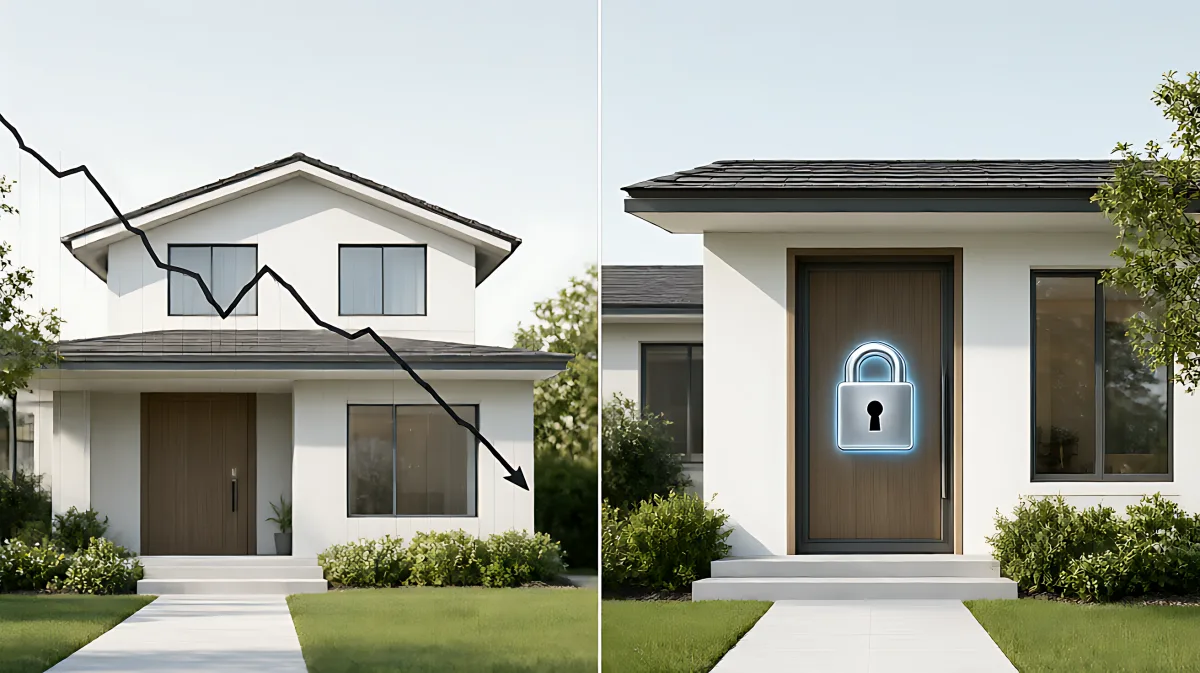
When housing values decline, reverse mortgage balances can outgrow home equity. Here is how federal rules protect borrowers and what you can do to manage the risk.
When housing values dip, reverse mortgage balances can grow faster than home equity, effectively pausing access to additional funds. However, federal rules cap total liability at the home's sale price, protecting borrowers and heirs from owing more than the property is worth. This non-recourse protection remains intact even in severe market downturns, ensuring no personal deficiency judgments against the estate.
How does a market dip impact reverse mortgage payouts?
Reverse mortgages, specifically Home Equity Conversion Mortgages (HECMs), do not have a fixed payout schedule that gets "suspended" in the traditional sense. Instead, the available credit line is dynamic. As the loan balance compounds with interest over time, the remaining available credit shrinks. If the home value drops significantly due to a market dip, the equity cushion erodes. Once the loan balance approaches the current appraised value of the home, the available credit can be reduced to zero. This means the borrower can no longer draw funds, not because the lender stopped payments arbitrarily, but because there is no remaining equity to secure new advances. Jason Eichmiller of Reverse Mortgage Reality notes that while rising rates affect qualification, the core issue during dips is the exhaustion of available credit due to the compounding balance.
What are the federal limits on liability during a downturn?
The federal non-recourse cap is the critical safety net. Under 12 USC §1715z-20, neither the borrower nor their heirs can owe more than the home's value at the time of sale. For example, if a home is appraised at $300,000 but the HECM balance has grown to $340,000, heirs who keep the home pay only 95% of the appraised value, which is $285,000. The Federal Housing Administration (FHA) Mutual Mortgage Insurance Fund covers the $55,000 difference. This rule applies regardless of how deep the market dip is; it is a statutory protection designed to prevent foreclosure based on estate assets or personal wealth.
Can borrowers refinance or sell during a market dip?
Yes, but the options are constrained. Borrowers or heirs can sell the home to any third party; the sale proceeds pay off the loan up to the sale price, and the FHA covers any shortfall. Alternatively, heirs can pay off the balance at the lesser of the loan balance or 95% of the current appraised value. Refinancing into a forward mortgage is also an option, but it requires the heir to qualify for a traditional loan. In a dipping market, finding a buyer for the home may take longer, which is why federal rules allow up to two 90-day extensions on documented good-faith effort, totaling a maximum 12-month disposition window from the maturity event.
What triggers the "due and payable" notice during financial stress?
Many families assume that market dips automatically trigger a loan default, but in fact, the loan only becomes due and payable upon specific maturity events: the death of the last surviving borrower, moving out for more than 12 consecutive months, selling the home, or defaulting on property obligations. A market dip alone does not trigger the due-and-payable notice. However, if a borrower falls behind on property taxes or homeowners insurance because their income is tight, that default becomes a trigger. HUD data indicates that failure to pay property charges is the most common cause of HECM foreclosure. Borrowers must keep these obligations current to avoid triggering the repayment clock.
How can homeowners protect their equity during market volatility?
Homeowners should monitor their loan balance and local appraised values regularly. If the available credit is nearing zero, they can explore a HECM refinance to a jumbo reverse mortgage if the home value is high enough to exceed FHA limits. For those in declining areas, focusing on maintaining the property is essential, as neglect can constitute a default. It is also wise to review the 2026 FHA lending limits, which are set annually, to understand the maximum loan amounts available. Engaging with a HUD-approved counselor is the first step in any strategic adjustment. Many lenders require proof that residents can afford basic upkeep; failing to show this financial capacity can disqualify a borrower from new funding.
- Monitor Equity: Check your loan balance and estimated home value quarterly to anticipate credit exhaustion.
- Maintain Property: Ensure taxes and insurance are always paid to avoid default triggers.
- Plan for Extensions: If a maturity event occurs, act within 30 days to notify the servicer and request extensions early.
- Consider Refinancing: If equity is low, explore jumbo HECM options or forward mortgages if the market stabilizes.
Does the FHA insurance fund cover shortfalls in all states?
Yes, the FHA Mutual Mortgage Insurance Fund provides non-recourse protection for all HECM loans insured by the federal government, regardless of the state in which the property is located.
Can I still use my reverse mortgage line of credit if the house value drops?
You can continue to use your line of credit only if you have available credit remaining. If the loan balance plus accrued interest equals or exceeds the current appraised value, the available credit will be zero, and no further draws are permitted.
What happens if heirs cannot afford to pay 95% of the appraised value?
If heirs cannot afford the 95% buyout, they can choose to sell the home to a third party or execute a deed-in-lieu of foreclosure. In both cases, they walk away with no further financial obligation, as the FHA insurance covers the remaining balance.
Do market dips affect the interest rate on my existing HECM?
No, the interest rate on an existing HECM is fixed or variable based on the original terms. Market dips do not change the interest rate structure of the loan, but they do affect the appraised value of the home, which impacts the maximum loan amount and available credit.