Detect Hidden Bank Fee Hikes: A Practical Audit Guide
Hidden bank fees often bury themselves in vague line items. Follow this step-by-step forensic approach to spot price drift, verify recurring charges, and reclaim your money.
Hidden bank fee hikes rarely appear as loud notifications; instead, they manifest as subtle "drift" in recurring charges or buried in dense fee schedules. To catch them, you must perform a comparative analysis of at least two monthly statements to identify recurring patterns and cross-reference these against your official account disclosure documents. This proactive audit allows you to distinguish legitimate usage-based fees from unapproved price increases or unauthorized service charges, enabling you to negotiate reversals before the next billing cycle.
Why Single-Statement Reviews Often Miss the Problem
Many consumers assume that checking their balance weekly is enough to stay financially safe, but in fact, this method fails to detect the slow accumulation of hidden costs. A single month of transaction history only shows you what happened, not what is likely to happen next. Subscription-style billing and recurring service charges are designed to repeat silently. If you look at only one snapshot, you see a charge but not the pattern. You cannot identify a price hike without comparing the current amount against a previous baseline to measure the gap.
How to Decode Vague Fee Labels on Your Statements
Bank statements often use generic descriptors like "service charge," "assessment," or "adjustment" that provide little context. These lines are where most hidden fees hide. You need to treat every non-purchase charge as an anomaly until proven otherwise. Focus your attention on the first and last business days of the statement period, as these are the standard posting times for maintenance and service fees. Additionally, look for any charge that lacks a corresponding merchant name. If you cannot identify who initiated the transaction, it is likely an internal bank fee rather than an external purchase. This distinction is critical because external merchants are easier to dispute, while internal fees require understanding your specific account agreement.
What Specific Triggers Activate These Hidden Charges?
Understanding the mechanics behind the fees helps you prevent them. Most hidden charges are tied to specific account states or behaviors. For example, dormancy fees are triggered when an account sees no transaction activity for a sustained period, often affecting secondary savings accounts you may have forgotten about. Minimum balance fees activate when your daily balance drops below a specific threshold, even if the account never reaches zero. Out-of-network ATM fees apply not just to the withdrawal itself, but often to a reimbursement fee charged by the ATM operator plus a separate fee from your bank. By mapping these triggers to your actual behavior, you can adjust your strategy to avoid the penalty entirely.
Step-by-Step Guide to Auditing Your Bank Fees
You do not need to be a financial expert to uncover these charges; you just need a systematic approach. The following checklist transforms your passive banking experience into an active investigation. Execute these steps to build a complete picture of your banking costs.
- Request the official Schedule of Fees: Do not rely on memory. Call your bank or visit the legal disclosures section of their website to obtain the current "Account Disclosure" or "Schedule of Fees." This document lists every possible charge for your specific account type.
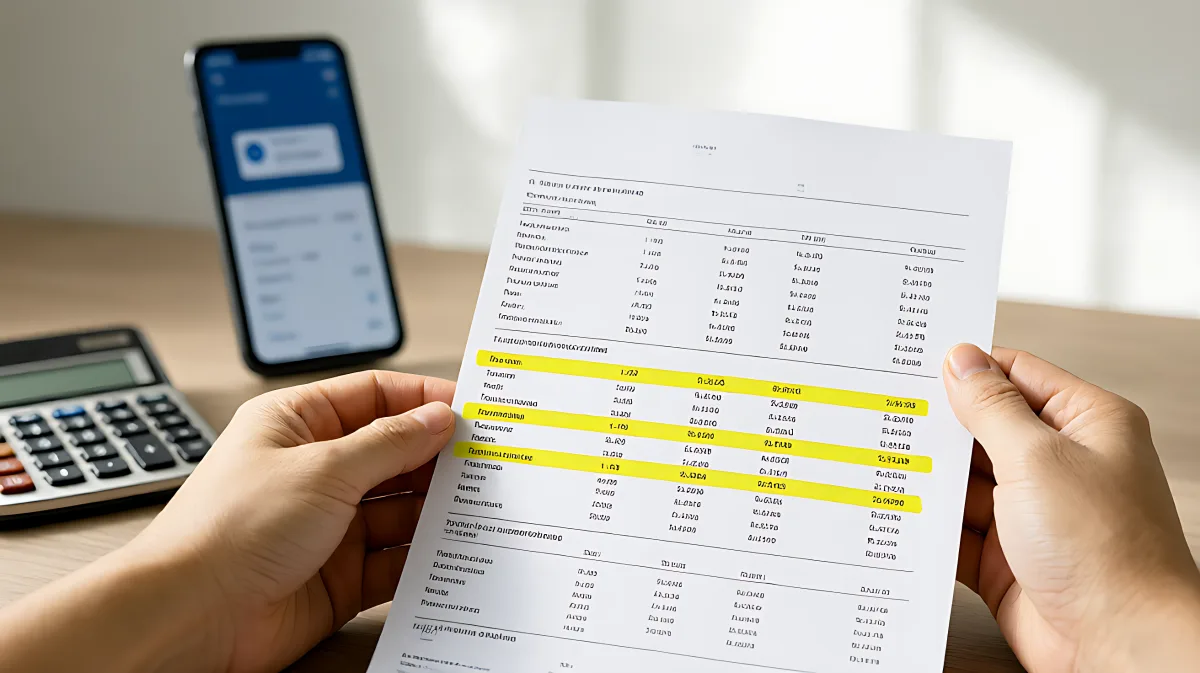
- Download three months of PDF statements: Avoid using the app's transaction view, which often groups fees. Use the full PDF statement for a line-by-line audit. Highlight every charge that is not a recognizable purchase.
- Calculate the drift: Compare identical recurring charges across the three months. Flag any group where the highest amount is at least 5% higher than the lowest. This indicates a potential price increase.
- Set preventative alerts: Configure your banking app to send notifications when your balance drops $100 to $200 above your minimum balance requirement. This gives you time to move funds and avoid maintenance fees before they post.
- Initiate a negotiation: Call your bank's customer service line, not a chatbot. State clearly that you have noticed the specific fee and request a reversal. Most banks have discretionary authority to waive one or two fees per year for loyal customers.
Common Mistakes That Keep Fees Hidden
One frequent error is assuming that because a fee appears every month, it is permanent and unchangeable. In reality, many fees are conditional waivers that you are losing because your account balance dipped slightly below the threshold. Another misconception is that paper statement fees are optional luxuries. For many users, switching to e-statements is the only way to eliminate this recurring cost. Finally, many people ignore dormant accounts. A forgotten secondary savings account can generate inactivity penalties that quietly drain hundreds of dollars annually without you ever logging in. These forgotten accounts are a primary target for dormancy fees, and clearing them out or opting into fee-free digital-only profiles is a necessary step in any comprehensive audit.
Table of Typical Hidden Fees and Their Triggers
The following table summarizes the most common hidden fee structures reported by consumer advocacy groups. Use this as a reference checklist when reviewing your own statements. Note that while regulatory limits on certain withdrawal fees have been suspended, banks retain the right to charge these fees if they are explicitly stated in the account agreement.
| Fee Type | Typical Cost Range | Activation Trigger |
|---|---|---|
| Monthly Maintenance | $5 to $15 | Falling below minimum daily balance |
| Paper Statement | $2 to $5 per month | Opting out of electronic statements |
| Out-of-Network ATM | $2.50 to $5 plus operator fee | Using an ATM outside the bank's network |
| Dormancy/Inactivity | $5 to $20 per month | No transactions for 6 to 12 months |
| Excessive Withdrawals | $5 to $15 per transaction | More than 6 withdrawals from savings monthly |
Frequently Asked Questions
Can I dispute a fee if it is listed in my account agreement?
Yes. Even if a fee is contractually valid, banks often have the discretion to waive it as a customer service gesture, particularly for first-time occurrences or for long-term customers. The goal of the dispute is not necessarily to prove the fee was illegal, but to negotiate a reversal and ensure you understand how to avoid it in the future.
How many statements do I need to detect a price hike?
You need at least two consecutive monthly statements to establish a baseline for recurring charges. A third statement is ideal for confirming whether a change is a temporary fluctuation or a permanent price adjustment. A single statement cannot show you that a charge has increased over time.
Do banks charge fees for calling customer service?
Some institutions do charge a fee for receiving service over the phone, especially if you have a specific account tier that includes free phone support. This fee is usually listed under "service charge" or "communication fee" in the detailed fee schedule. Check your specific account disclosures to see if this applies to your profile.
Is it safer to keep my data in a cloud banking app?
While cloud apps are convenient, local processing of statement data offers greater privacy. Tools that parse files locally ensure that sensitive financial details are not transmitted to external servers for analysis. Always verify that any third-party tool you use employs local processing or encrypted data handling to protect your financial identity.