Ladder Safety for Seniors: How to Stay Stable and Independent
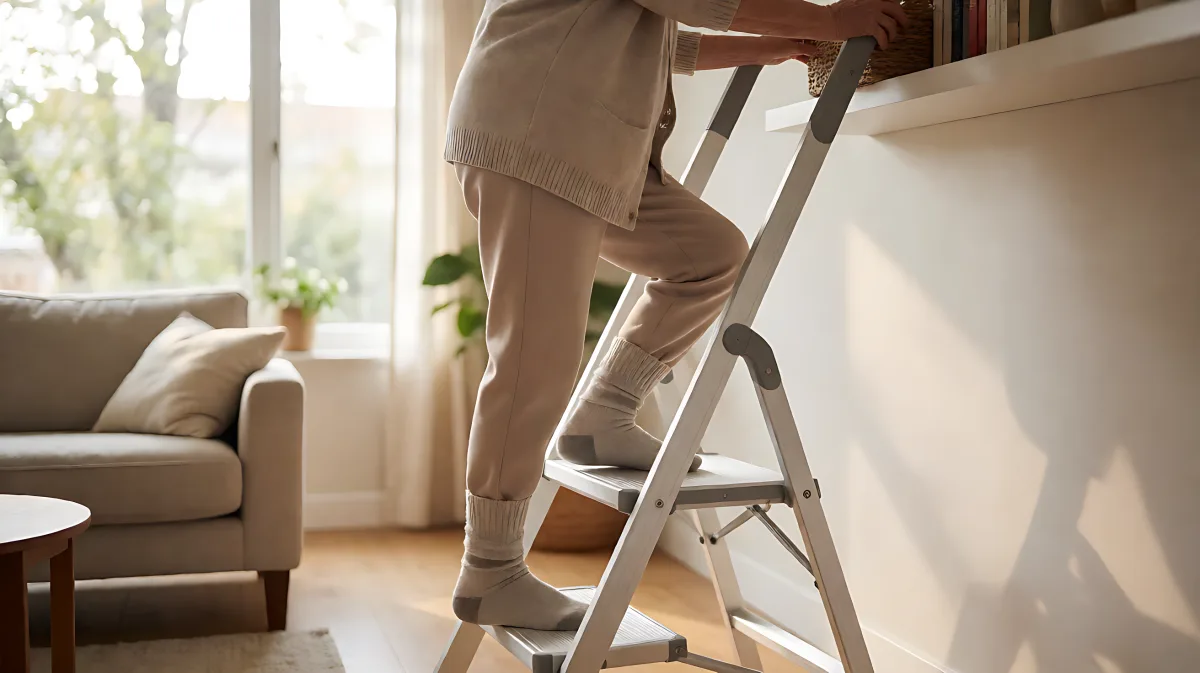
Ladder safety for seniors requires a shift in focus from reach to stability. This guide explains how to choose a ladder with wide steps and handrails to prevent the most common injury among older adults.
For older adults, ladder safety depends on prioritizing stability over height. The most critical step is choosing a low-to-the-ground model with wide, slip-resistant steps and a handrail that provides a secure third point of contact while climbing. The National Institute of Aging notes that falls are the leading cause of injury among seniors, making proper equipment selection a matter of health, not just convenience. By focusing on a wider base, automatic locking features, and a height that does not require full extension, you can complete household tasks while significantly reducing the risk of a fracture or fall.
Why Ladder Safety Changes for Older Adults?
Physical changes that occur with age directly impact how a person interacts with a step ladder. Reduced muscle mass and slower reaction times mean that a wobble that might be easily corrected at a younger age can result in a serious fall at 65 or older. According to safety data from 2025, more than 500,000 Americans are treated in emergency rooms for ladder-related injuries annually. While the majority of these occur during commercial or industrial work, a significant portion of these injuries happen in homes during simple tasks like changing light bulbs or cleaning high windows.
The National Institute of Aging emphasizes that the loss of muscle strength, which can decrease by 3 to 8 percent per decade after age 30, makes it more difficult to hold onto a ladder or maintain a secure footing. Additionally, age-related changes in vision can affect depth perception, making it harder to see the exact edge of a narrow step. This is why a ladder that feels "fine" to a younger family member may feel unstable and unsafe to a senior. The goal is not to abandon independence, but to use a tool that compensates for these physical changes by providing more support and a lower center of gravity.
What Features Make a Ladder Safe for Seniors?
Selecting the right equipment requires looking past marketing labels for specific structural details. A senior-friendly ladder is not just a smaller version of a standard construction ladder; it is designed with wider proportions and additional support points. The most important feature is a handrail or a tall, sturdy handle. This allows the user to maintain three points of contact at all times, which is the foundational rule of ladder safety. Without a handrail, a user must use both hands to hold the ladder, leaving them without a way to brace themselves if they stumble.
Equally important are the dimensions of the steps themselves. Standard rungs are often only 1.5 to 2 inches wide, which is too narrow for an entire foot. Senior-safe models feature steps that are at least 3 to 4 inches wide, providing a stable platform that reduces the strain on ankles and knees. Furthermore, the feet of the ladder should be large, with diameters of 2 inches or more, featuring deep treads to prevent sliding on smooth hardwood or tile floors.
How Do You Choose the Right Height and Weight Capacity?
Many seniors assume that a ladder with a very high weight capacity is always the best choice, but in fact, the capacity is less important than the actual weight of the ladder itself. A heavy steel ladder that can hold 500 pounds may be too heavy for an older adult to lift and position safely on their own. If the tool is difficult to move, it is more likely to be dragged over an uneven surface, leading to a fall or injury. Instead, look for a lightweight aluminum construction that supports a rating of at least 300 pounds. This provides a high safety margin for most users while remaining manageable to transport from the garage or storage area. For most household tasks, a 2-step or 3-step ladder is sufficient; anything taller introduces unnecessary tipping risks.
How Should a Senior Use a Ladder Safely?
Even the best-designed ladder can become dangerous if it is not used correctly. The first step is to ensure the ladder is placed on a flat, level surface that is free of clutter. For extension ladders used on the outside of a home, the "four-to-one" rule is standard, but for seniors, a 3-step step ladder is safer because it does not require leaning against a wall. When climbing, move slowly and maintain focus. Do not look up or down while shifting your weight.
- Check the locking mechanism: Ensure every hinge and lock is fully engaged before stepping on the ladder.
- Face the ladder: Always face the steps while climbing or descending. Never turn your back to the steps while on the ladder.
- Keep the center of gravity: Do not lean out past the rails of the ladder to reach for objects.
- Limit the load: Carry only essential tools. A heavy toolbox will shift your balance and make it harder to hold the handrails.
It is also critical to check the condition of the ladder before every use. Look for rust, cracked hinges, or stripped threads on the feet. A ladder that is damaged is a ladder that should be replaced immediately, not just taped or wrapped.
What Are Common Ladder Mistakes to Avoid?
One of the most common mistakes seniors make is trying to reach a height that is out of the ladder's range. If you cannot comfortably reach a high cabinet while standing on the top step, the ladder is too short. Do not stand on the top two steps of a step ladder, as this raises your center of gravity and makes the ladder prone to tipping. Many users also forget to secure the ladder on slippery floors. Placing a small piece of cardboard or a dedicated rubber mat under the feet can significantly increase traction without damaging the floor.
Another frequent error is using a ladder in wet or rainy conditions. If you must work outdoors on a wet day, pause and wait for the surface to dry, or use a ladder with feet specifically designed for wet concrete or brick. Finally, avoid using a ladder if you are feeling dizzy or unwell. Reaction time is key to preventing a fall, and if your physical state is compromised, the task should wait until you are at your best.
FAQ
What is the safest ladder for a person with arthritis?
A low, 2-step aluminum ladder with a full-height handrail and wide, non-slip steps is generally the safest. The handrail reduces the need for gripping the sides, and the wide steps prevent the ankle rotation that can trigger arthritis pain. Avoid ladders with narrow rungs or those that require a high physical effort to move.
Can a senior use an extension ladder?
Extension ladders are more dangerous for seniors due to their weight and the complex angle required for setup. If an extension ladder is the only option for a specific outdoor task, it should be supervised by another person who can hold the base. For most household maintenance, a lightweight, compact step ladder is a safer and more manageable alternative.
How often should a senior ladder be inspected?
You should inspect your ladder before every single use. Look for loose hinges, broken locks, and worn-out feet. If the ladder has been dropped or used in harsh conditions, a professional check is recommended immediately. In terms of replacement, a high-quality aluminum ladder can last for decades if cared for, but if you notice any permanent bending, it is time to buy a new one.