Cognitive Load and Clutter: How to Reduce Mental Overload
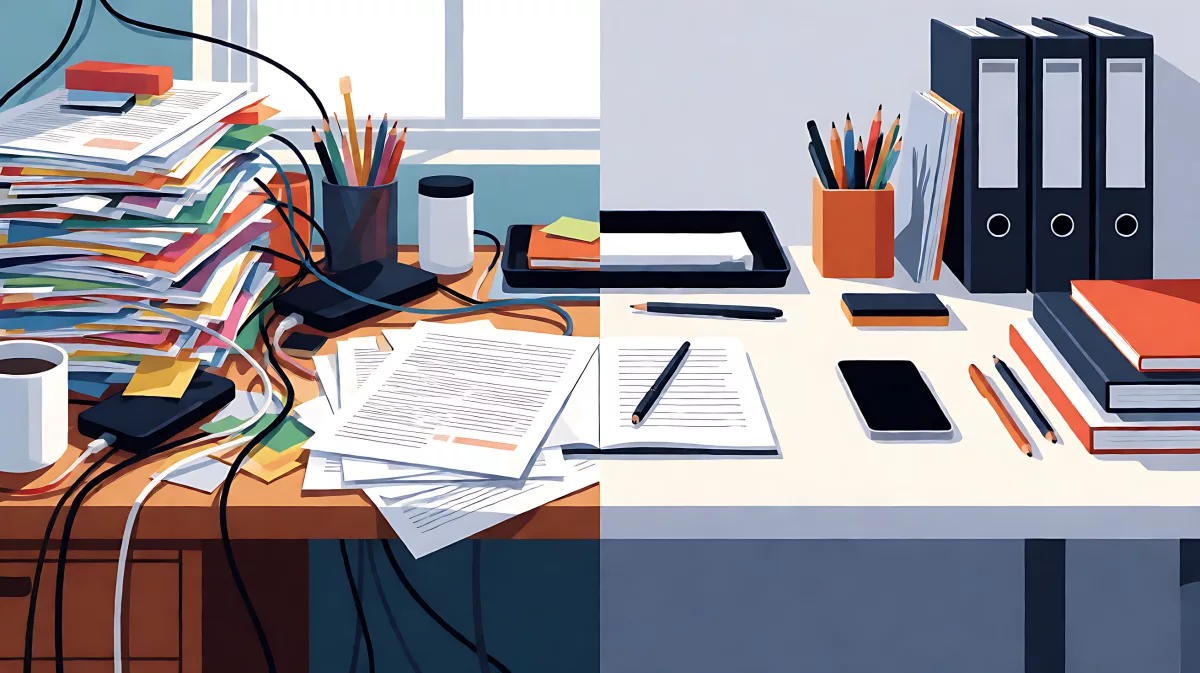
Clutter is not just a visual nuisance; it is a safety hazard. Learn how reducing cognitive load through organized environments and clear design can prevent errors and improve decision-making.
Cognitive load is the total mental effort required to process information, and clutter significantly increases this burden, leading to slower reaction times and higher safety risks. By reducing visual noise and simplifying interfaces, you can lower the strain on your working memory. This allows for clearer decision-making and fewer errors in high-stakes environments.
Why Does Clutter Harm Your Mental Performance?
Imagine trying to read a map while a dozen other people are shouting directions at you. The noise doesn't just annoy you; it makes it harder to process the actual directions. This is the essence of cognitive load. Your brain has a limited capacity for working memory at any given moment. When your environment is filled with unnecessary items, data points, or visual distractions, your brain must spend energy filtering out the irrelevant to find the signal.
According to the Nielsen Norman Group, a leading user research and consulting organization, this filtering process consumes mental resources that should be reserved for task performance. When these resources are depleted, performance drops. This drop is not just about feeling tired; it is about a measurable decrease in the ability to hold information in memory for short periods. In safety-critical scenarios, such as operating machinery or driving, this decrease can lead to critical errors.
What Are the Three Types of Cognitive Load?
Understanding the source of the load is the first step to managing it. Researchers generally categorize cognitive load into three distinct types. Each type affects how we interact with our surroundings and tools.
- Intrinsic Load: This is the inherent difficulty of the task itself. Learning to fly a plane has high intrinsic load. It is complex and requires significant mental effort. You cannot easily remove this without changing the task.
- Extraneous Load: This comes from the way information is presented. If a pilot manual is confusing, uses poor layout, or includes irrelevant data, you are adding extraneous load. This is where clutter and poor design have the most impact. You can remove this entirely without affecting the core task.
- Germane Load: This is the effort devoted to learning and schema construction. This is the "good" load. It helps you build mental models. The goal is to minimize extraneous load so you have more mental space for germane load.
How Does Visual Clutter Drive Extraneous Load?
Visual clutter is the physical manifestation of extraneous load. It includes unorganized desks, crowded dashboard interfaces, and walls covered in unnecessary posters. Every element you see is processed by your visual cortex. While some processing is automatic, the need to distinguish relevant objects from background noise requires active attention.
The Gestalt principles of visual perception explain how we group items. Principles like proximity and similarity help the brain organize visual input. However, when objects are too close or too similar without clear hierarchy, the brain struggles to group them correctly. This struggle is a direct drain on cognitive resources. For example, a factory control panel with fifty identical buttons creates visual noise. The operator must spend energy determining which button is the emergency stop versus a standard function.
What Role Do Mental Models Play in Reducing Load?
Mental models are internal representations of how things work. When a new system aligns with your existing mental models, you spend less energy learning it. If a car's dashboard uses icons that resemble the real-world switches and gauges, you understand them instantly. If a software app uses a metaphor that does not make sense, you must pause to figure out the logic.
The Nielsen Norman Group advises designers to build on existing mental models. When a design violates these expectations, it forces the user into a state of confusion. This confusion adds to the extraneous load. In safety contexts, such as in hospitals or air traffic control, this added load can delay critical actions. Standardizing interfaces and using familiar patterns reduces the need for new learning, freeing up bandwidth for the actual work.
How Can You Offload Tasks to Improve Safety?
One of the most effective ways to reduce cognitive load is to offload tasks to external tools or systems. This means writing things down, using checklists, or automating routine processes. If you rely on your brain to remember where you left your keys or what the next step in a procedure is, you are taxing your working memory.
Consider the concept of "working memory" limits. Research suggests that adults can typically hold only four to seven items in their working memory at once. Clutter and complex interfaces compete for these slots. By using checklists, you move that information to paper or a screen. Your brain no longer needs to hold it; it just needs to execute it. This shift is crucial in safety. A medical professional using a standardized pre-surgery checklist is offloading the task of remembering steps, allowing them to focus on the patient's condition.
What Are Practical Steps to Reduce Clutter and Load?
You do not need a complete overhaul to start reducing cognitive load. Small, targeted changes can have a significant impact. Here are specific strategies to implement in your workspace or digital environment.
- Declutter Physical Surfaces: Keep only essential items on your desk. Every object out of sight is one less thing your brain might try to process as a potential distraction.
- Simplify Digital Interfaces: Close unused tabs and disable notifications. Visual noise in software is just as fatiguing as noise in a room.
- Use Clear Hierarchy: If you are designing a space or document, use size, color, and spacing to guide attention. The most important information should be the most obvious.
- Apply Gestalt Principles: Group related items together. Use whitespace to separate unrelated sections. This helps the brain process information in chunks rather than as a chaotic whole.
Why Is Managing Cognitive Load a Safety Issue?
Cognitive load is often treated as a matter of comfort or productivity, but it is fundamentally a safety issue. When mental bandwidth is overwhelmed, decision-making quality degrades. This phenomenon is known as "cognitive tunneling," where attention narrows to a single point and peripheral awareness drops.
In a high-stress environment, such as a busy kitchen or a construction site, cognitive tunneling can cause you to miss hazards. For example, a chef focused on a complex dish might not notice that a pan is overheating because their mental resources are fully allocated to the recipe steps. By reducing extraneous load, you widen the net of attention. You allow the brain to remain aware of the broader context. This awareness is the first line of defense against accidents.
Frequently Asked Questions
Does a messy room actually make me think slower?
Yes. Studies have shown that a cluttered environment can hinder attention and the ability to prioritize tasks. The brain spends extra energy filtering out irrelevant items, which reduces the resources available for focused thought and decision-making. This can lead to slower reaction times and increased errors.
What is the difference between intrinsic and extraneous load?
Intrinsic load is the difficulty of the task itself, like learning a new language. Extraneous load is the difficulty added by how the task is presented, like a confusing textbook or a cluttered screen. You cannot change the intrinsic load of the task, but you can significantly reduce extraneous load by improving design and organization.
How can I apply Gestalt principles to my workspace?
Use proximity to group related items, such as keeping your pen, notepad, and phone together. Use similarity to indicate related functions, like grouping all software icons by color. Use closure to create visual boundaries, such as using trays or folders to contain items. These techniques help your brain process the space in organized chunks rather than as a chaotic whole.
Is it better to have less information or better-organized information?
Better-organized information is generally superior, provided it remains relevant. Removing all information can create a gap that hinders performance. However, removing clutter (irrelevant information) is almost always beneficial. The goal is to have the right information, presented in a way that minimizes the mental effort required to process it.