ABCDE Melanoma Checks for Older Adults
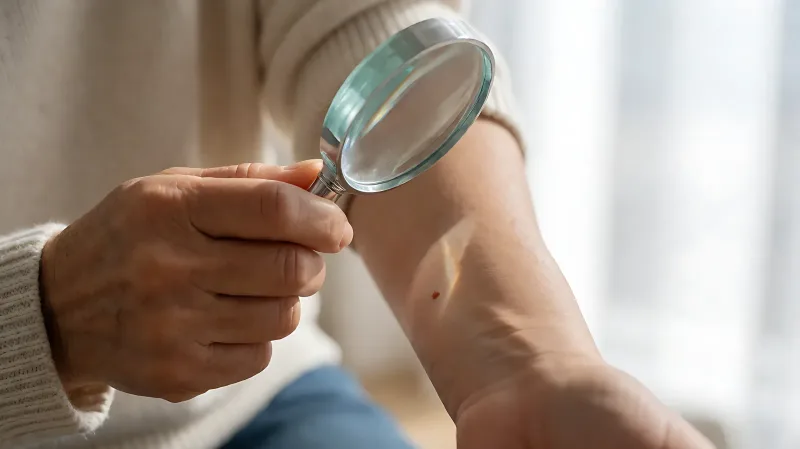
Aging skin changes constantly. This guide explains how the ABCDE method helps older adults distinguish harmless moles from early melanoma signs, ensuring you know exactly when to see a specialist.
Older adults face a higher risk of melanoma, but early detection can be highly effective. The ABCDE system checks for asymmetry, border irregularities, color variation, diameter, and evolving changes. If a mole exhibits one or more of these traits, the American Academy of Dermatology recommends a prompt visit to a professional for a full evaluation.
For more information, see NIA health information for older adults from the National Institute on Aging.
What is the ABCDE method and why does it matter?
Developed by the American Academy of Dermatology, the ABCDE mnemonic helps patients spot melanoma in its earliest stages. The system evaluates a specific spot on the skin by looking for five key characteristics that often deviate from the appearance of a standard, harmless mole. While a common nevus tends to be uniform and symmetrical, a malignant lesion frequently looks "off" or irregular. This rule of thumb is a foundational tool for both self-checks and professional dermatological exams.
Dr. Margaret Tucker, a principal investigator for the NCI Familial Melanoma Study, noted that melanomas vary widely in appearance and that patients must learn to distinguish normal changes in their skin from those that require medical attention. NCI’s Division of Cancer Epidemiology and Genetics (DCEG) spent decades gathering photographs of 29 different types of pigmented lesions to create educational tools that highlight these subtle distinctions.
How do I interpret each letter of ABCDE?
The five letters each stand for a specific physical trait you should examine in the mirror or with a full-length mirror:
- Asymmetry: If you draw an imaginary line through the center of the spot, the two halves do not match up.
- Border: The edges are ragged, notched, or poorly defined rather than smooth and even.
- Color: The color is not a single, solid shade. Instead, it includes various tans, browns, blacks, or even reds, blues, and whites.
- Diameter: The spot is usually larger than 1/4 inch (about the size of a pencil eraser). However, a melanoma can be smaller, so size is just one factor.
- Evolving: The most critical sign. The mole has changed in shape, color, or size within the past few months or years.
Why is melanoma more dangerous as we age?
Skin is the largest organ in the human body, and its health changes as the years go by. The National Cancer Institute (NCI) reports that the number of new melanoma cases in the United States has been climbing for the last four decades. Melanoma is not just a risk for younger people; it is one of the most common types of cancer for older adults.
While melanoma is more deadly than common skin cancers like basal cell carcinoma, its mortality rate drops drastically if found early. Between 2004 and 2010, 98 percent of melanoma patients whose cancer had not spread beyond the initial location on the skin survived at least five years. This statistic underscores the importance of recognizing the ABCDE signs in your own skin, as early treatment is the key to a positive outcome.
What changes in skin should senior patients watch for?
The term "Evolving" in the ABCDE rule is perhaps the most important for those over 60. NCI emphasizes that patients should check their skin monthly and be aware of changes in pigmented lesions. A mole that was stable for years can suddenly start growing, changing color, or developing new symptoms.
It is also vital to understand the difference between a benign nevus and a dysplastic (atypical) mole. Atypical moles can increase your overall risk of developing melanoma. The NCI launched the "Moles to Melanoma" tool to help people visualize the progression of these lesions, showing how a small, standard mole can develop into a cancerous one over time.
Are there specific risks for darker skin tones?
Skin cancer can happen to anyone, regardless of their skin color. The NCI notes that while their photo tools were based on a study of primarily white participants, it is essential for all individuals to know their risks. For people with darker skin, melanomas often appear in less sun-exposed areas, such as the palms of the hands, the soles of the feet, and the toenails. These areas are frequently overlooked during a standard bathroom mirror check.
When should you see a dermatologist?
A board-certified dermatologist is the only professional who can definitively diagnose melanoma. They use the ABCDE system but also consider your personal medical history and family history of skin cancer. The American Academy of Dermatology recommends that if you notice a new spot or an old one that is changing, you should schedule an appointment.
In addition to checking for specific moles, you should also be aware of other skin changes. Melanoma is not the only form of skin cancer, but it is the most serious. If you have a history of severe sunburns, frequent use of tanning beds, or a family history of the disease, you may need more frequent professional screenings.
What is a dermoscopy exam?
During a professional visit, a dermatologist will often perform a dermoscopy exam. This involves using a specialized magnifying tool to look at the pigment and structure of a mole in greater detail than the naked eye allows. It is a non-invasive way to determine if a lesion needs to be biopsied.
How can you maintain a healthy skin routine?
Prevention is as important as detection. The AAD and NCI both recommend a consistent routine to protect your skin from further damage and to keep it in good condition. This routine should include sun protection and regular, thorough self-examinations.
| Routine Step | What To Do |
|---|---|
| Sun Protection | Use broad-spectrum sunscreen with an SPF of 30 or higher on all exposed skin daily. Wear a wide-brimmed hat and protective clothing when outdoors. |
| Self-Check | Use a full-length mirror to check your back, arms, and legs. Look at your scalp and the soles of your feet with a hand mirror. |
| Professional Exam | See a dermatologist annually, or more often if you have a high-risk profile. Ask them to mark and monitor any atypical moles. |
Frequently Asked Questions
What is the "E" in the ABCDE of melanoma?
The E stands for evolving or changing. It is a warning sign that a mole is changing in size, shape, or color, or that it has developed new symptoms like bleeding or itching. This change is often the most reliable indicator of a potential melanoma.
Can older adults still get sunburns that cause cancer?
Yes. Older adults can still suffer from acute sunburns and chronic sun exposure, both of which contribute to the risk of all types of skin cancer. NCI research shows that cumulative sun damage over a lifetime significantly increases the risk of melanoma in later life.
What is the difference between a nevus and a melanoma?
A nevus is a common mole, which is a cluster of pigment cells. It is generally harmless. A melanoma is a cancerous growth of those same pigment cells. While a nevus is stable, a melanoma will show the ABCDE characteristics of asymmetry, irregular borders, and color changes.
Does a doctor's visit hurt?
A standard full-body skin exam is generally not painful. The dermatologist may feel for bumps or lumps in the skin. If they decide a mole is suspicious, they will perform a minor biopsy, which involves a local anesthetic and a small needle to remove a sample of the tissue for a lab test.