How Shoe Width Affects Balance and Stability
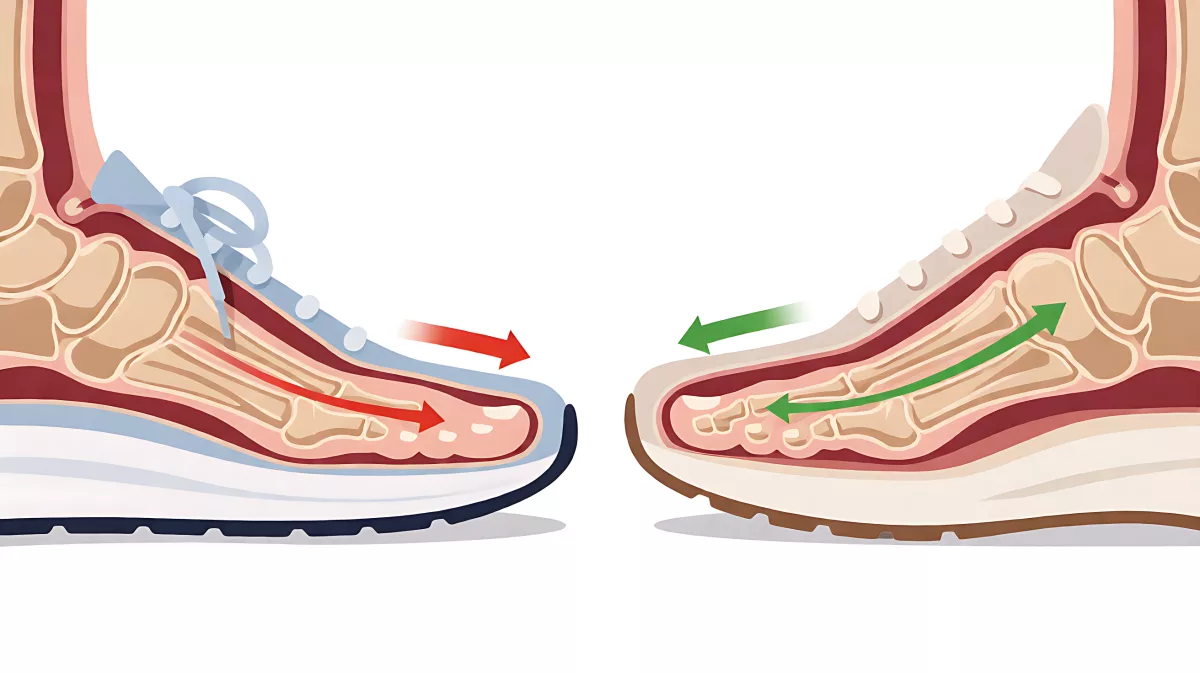
The width of your shoe's toe box does more than affect comfort; it directly influences your foot's ability to sense position and maintain balance. This guide explains how restriction vs. space changes your stride and stability.
Shoe toe box width directly influences foot balance by controlling how naturally your toes can splay to stabilize your weight. When toes are compressed, your body must use more energy to maintain equilibrium, leading to quicker fatigue and a higher risk of missteps or falls. Conversely, a wider toe box allows for better proprioception, the sense of where your foot is in space, which enhances overall stability during movement.
Why does toe box width affect balance?
The front of your foot is not just for support; it is a complex sensory network. Your toes act as tiny stabilizers that adjust to uneven ground. When a shoe forces them into a narrow, parallel alignment, these stabilizers are disabled. Research in biomechanics suggests that restricted toe movement can reduce the foot's ability to dampen shock and adjust to lateral shifts in weight. This lack of feedback forces your calves and knees to compensate, which can disrupt your natural center of gravity. As of 2026, podiatrists frequently cite excessive toe compression as a primary contributor to chronic ankle instability, especially in adults who spend significant time on their feet.
How does a narrow toe box change your stride?
When your toes cannot spread, your foot acts more like a rigid plank than a flexible shock absorber. This rigidity often leads to a shorter stride length and increased vertical oscillation, meaning you bounce up and down more with each step. This inefficient gait consumes roughly 15 percent more energy over long distances. For those recovering from foot issues or managing arthritis, this added mechanical load can turn a casual walk into a source of joint pain, particularly in the metatarsals and the ankle. The restricted space also increases friction between toes, potentially leading to conditions like bunions or hammertoes that further compromise your ability to balance.
What is the ideal width for better stability?
There is no single universal measurement, but the general rule is that your toes should have enough room to splay naturally without hitting the sides of the shoe. A good fit test is the "thumb rule": you should be able to fit a finger vertically between the end of your toe and the shoe's tip, and your toes should not crowd against each other. For many individuals with wide feet, moving from a "Medium" width to a "Wide" or "Extra Wide" option can significantly improve postural alignment. Brands like Propet and other comfort-focused manufacturers now design lasts with wider forefeats to accommodate this natural variation, recognizing that a standard narrow last often fails to provide the base of support necessary for safe, balanced walking.
How do you test your shoe's impact on balance at home?
You can perform a simple single-leg stand test to see if your footwear is limiting your stability. Put on the shoes you want to evaluate, then stand on one foot with your eyes closed. If you feel a strong urge to open your eyes or shift your weight rapidly, your foot is likely struggling to sense the ground. Try the same test with your shoes off. If the barefoot test is significantly more stable than the shoed test, the shoe's toe box may be too narrow, restricting the sensory input your foot needs to auto-correct your balance. This is a practical DIY check that doesn't require specialized equipment. You can also observe your foot on a non-slip towel; if the toes are pressing hard against the walls of the toe box, you are losing leverage. In such cases, consider loosening laces or trying a wider last, as even small adjustments to pressure distribution can make a noticeable difference in how steady you feel during daily activities.
Does shoe height matter as much as width?
Yes, but width is the primary factor for the forefoot. While heel counter stiffness helps with rearfoot stability, the toe box width dictates how your foot engages with the ground surface. A high-cut shoe with a narrow toe box is less stable than a low-cut shoe with a wide, natural toe box because the forefoot is the final point of contact that adjusts to the terrain. Most modern athletic and comfort shoes, such as those from Tyrol Pickleball or Oboz, emphasize "roomy toe boxes" specifically to allow for this free movement, acknowledging that a snug, narrow fit does not equal a supportive fit.
Can you fix balance issues by widening your current shoes?
For leather or synthetic shoes, professional stretching can add a small amount of room, but it rarely transforms a narrow last into a wide one. If your shoe is fundamentally too narrow, stretching may stretch the material but not the interior structure, leaving the toe box compressed. A more effective DIY repair is to use toe spacers or metatarsal pads to redistribute pressure, but this is a temporary fix. For long-term balance, swapping to a shoe designed for your foot width is the superior solution. Retailers now offer specific "Extra Wide" categories, such as those found at ComfortWiz, which cater to people whose feet fall outside the standard narrow-to-medium range. These shoes often have a wider last that allows the foot to fan out, which naturally increases the surface area of contact with the ground, creating a more stable base for your entire body.
What role do orthotics play in this equation?
Orthotics can help align the foot, but they do not replace the need for a properly sized toe box. If an orthotic is too wide for the shoe, it can crowd the toes, negating the benefits of the support. Always ensure that your orthotic fits comfortably within the forefoot space. If you need both width and arch support, look for shoes with a removable insole and a naturally wide forefoot, allowing you to insert your own orthotic without compressing the toes. This combination is crucial for seniors or those with foot deformities who rely on visual and tactile cues to maintain balance.
FAQ
Does a wider shoe actually make me more stable?
Yes. A wider shoe allows your toes to spread and grip the ground, which activates intrinsic foot muscles that help stabilize the ankle and knee. This natural splaying provides a larger base of support compared to a narrow shoe that forces toes together.
How do I know if my toe box is too narrow?
Check for redness or bruising on the toes after wear. If you feel pressure on the sides of the big toe or pinky toe, or if your toes cannot touch when the shoe is laced, the box is likely too narrow for your anatomy.
Can I wear wide shoes for running?
Many runners find that wider shoes reduce the risk of stress fractures and blisters by allowing natural toe splay. However, you must ensure the shoe has enough heel support. A shoe that is too wide overall can cause the foot to slide, so look for models with a secure heel cup combined with a wide forefoot.
Do orthotics make the shoe tighter in the toe box?
They can. Thick orthotics take up volume in the shoe. If you have limited forefoot space, ensure your orthotic is thin or that you have sufficient room in the toe area to accommodate both the device and your toes without compression.