Hearing Aid Volume Adjustments for Noisy Settings
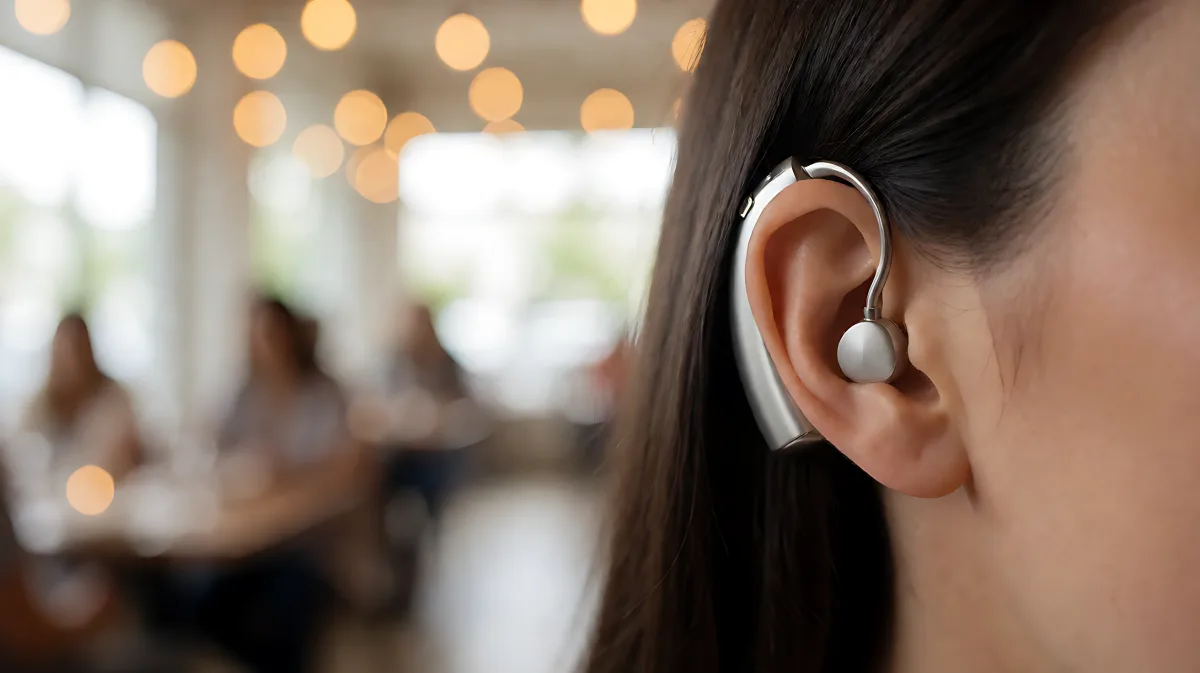
Master the art of hearing aid volume control. Discover specific settings and strategic habits to cut through background noise in restaurants and social gatherings, making conversations clearer and less tiring.
Adjusting your hearing aid volume alone is rarely enough for noisy environments. Instead, you should activate specific noise-reduction programs and directional microphone modes to isolate speech from background clatter. As an audiologist at HearUSA notes, for your brain to easily understand speech, the person talking must be noticeably louder than the surrounding noise. In busy settings, these levels are often similar, causing strain. Using dedicated programs and strategic seating significantly improves clarity.
Why is it so hard to hear in noisy restaurants and cafes?
Restaurants present a unique acoustic challenge because they combine multiple overlapping sound sources. You are dealing with conversations from nearby tables, clattering dishes, background music, and ambient hum from coffee machines or air conditioning. For a hearing aid user, this creates a "cloud of sound" that can mask the voices you actually want to hear.
Many hearing aid users assume that turning up the volume will solve the problem. In fact, increasing the volume indiscriminately often amplifies the background noise along with the speech, making the conversation harder to follow and leading to greater listening fatigue. The issue is not just audibility; it is the brain's ability to separate the target voice from the competing background. This is where sophisticated hearing aid technology comes into play.
How do directional microphones and noise reduction work together?
Modern hearing aids utilize directional microphones to focus on sounds coming from the front, where your conversation partner is located, while suppressing noise from the sides and behind. This is crucial in a restaurant where noise comes from all directions.
Furthermore, digital noise reduction algorithms can identify steady sounds, such as the hum of an air conditioner or the buzz of kitchen appliances, and suppress them in real time. Combined with speech enhancement features that boost specific frequencies essential for clarity, these technologies help you focus on the person talking. According to Southwestern Hearing, receiver-in-canal (RIC) and behind-the-ear (BTE) styles often outperform smaller hearing aids in high-decibel rooms because they accommodate larger batteries and more advanced directional systems.
What specific settings should I adjust for better clarity?
To optimize your experience, you need to move beyond simple volume adjustments. Most devices offer a dedicated "Restaurant" or "Party" program. This mode is calibrated to reduce background chatter while enhancing speech. Here is a checklist to follow when entering a noisy establishment:
- Switch to the dedicated program: Manually select the "Restaurant" or "Noisy" mode before or just as you sit down. This prioritizes speech frequencies.
- Verify microphone direction: Ensure your hearing aids are set to directional or focused mode, not omnidirectional. Omnidirectional is for quiet settings where you need to hear from all around.
- Pair a streamer if available: If your companion has a remote microphone or a Bluetooth streamer, connect to it. This allows you to hear their voice directly, bypassing the background noise entirely.
- Fine-tune volume: Use manual adjustments to lower the overall amplification slightly. This can reduce the impact of background noise while still allowing you to hear speech.
As of 2026, many premium devices include AI-driven adaptive noise reduction that automatically adjusts these settings based on the environment. However, manual overrides often provide the most personalized comfort in unique social scenarios.
What environmental strategies complement hearing aid adjustments?
Technology is powerful, but your physical positioning matters just as much. Strategic seating can reduce the number of noise sources surrounding you. Choose a booth or a corner table with your back to a wall. This prevents noise from arriving from behind you, a direction your directional microphones are least equipped to handle.
Additionally, consider the timing of your visit. Avoid peak hours when ambient noise levels are at their highest. A quieter dining experience reduces the cognitive load on your brain, allowing you to enjoy the meal rather than just surviving it. For those with severe hearing loss, an assistive listening device, such as an FM system, can provide a direct signal-to-noise ratio that hearing aids alone cannot achieve.
Frequently Asked Questions
Should I always use the highest volume in noisy places?
No. Many users assume louder is better, but high volume can distort speech and increase background noise. Instead, use moderate volume combined with directional microphones and noise reduction programs to improve the signal-to-noise ratio.
How often should I have my hearing aid settings adjusted?
It is recommended to have a check-up with a hearing care professional at least once a year. They can fine-tune the noise reduction settings to match your specific hearing loss profile and preferred environments.
Do all hearing aids have a restaurant mode?
Most modern digital hearing aids have a dedicated program for noisy environments, often labeled as "Restaurant" or "Party." However, the effectiveness of this mode varies by brand and model, with premium devices offering more advanced AI-based noise suppression.