China's 2026 Tech Milestones: Deep Sea, Space & AI Updates
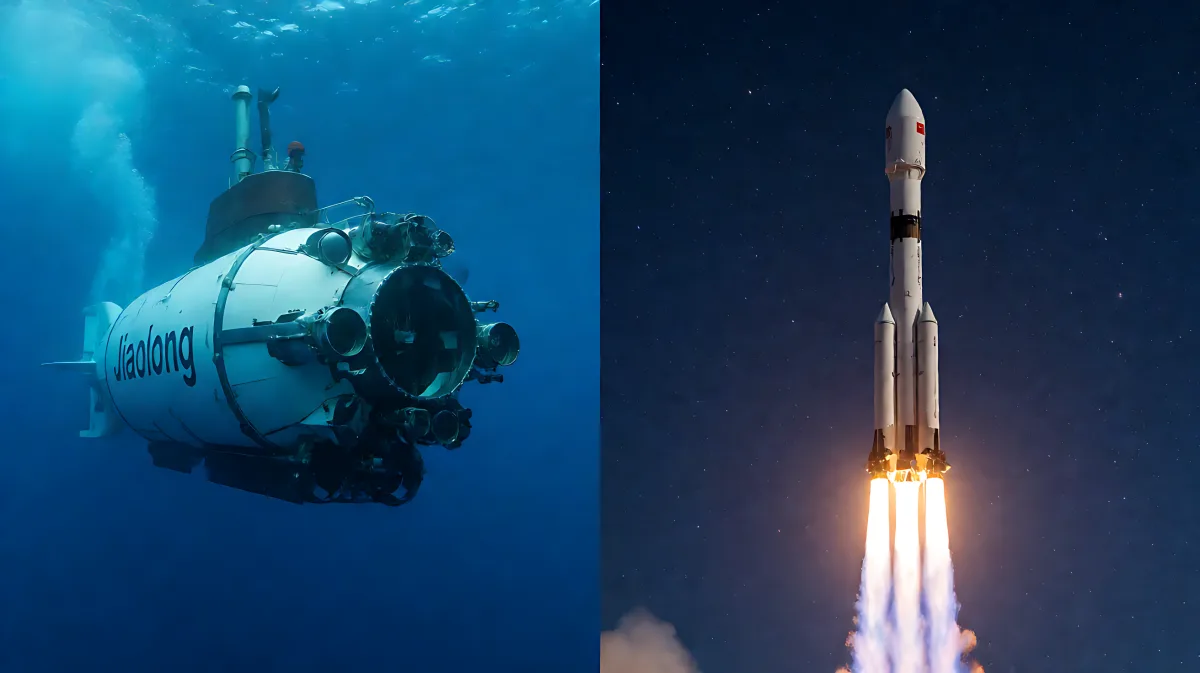
From the bottom of the Pacific Ocean to the orbit of low-earth satellites, China is accelerating its technological footprint in 2026. Here is what you need to know about the latest milestones in robotics, space exploration, and artificial intelligence.
China has recently accelerated its technological push in 2026, highlighting breakthroughs in deep-sea exploration, satellite internet, and artificial intelligence. The state-owned science news outlet reported that the 'Jiaolong' submersible is embarking on its first operational mission in the South Pacific, while the Long March 12 rocket successfully deployed a new group of low-orbit internet satellites. These developments align with central government directives to develop 'new productive forces,' a strategy aiming to shift the economy toward high-tech and high-value sectors.
What new deep-sea missions are being launched?
The China Ocean 100 Voyage, specifically its second leg, recently set sail with the 'Jiaolong' (Dragon) manned submersible. This mission marks a significant expansion of China's deep-sea research into the South Pacific basin. The submersible is designed for operations at extreme depths, allowing scientists to collect geological and biological samples that were previously difficult to access. This voyage is part of a broader national strategy to map ocean resources and understand climate changes in the Southern Hemisphere. Concurrently, in the energy sector, the port of Yangkou in Rudong, Jiangsu Province, recorded the arrival of its 900th liquefied natural gas (LNG) vessel, underscoring the critical infrastructure supporting China's industrial energy needs.
How is satellite internet evolving in 2026?
The space sector is seeing rapid pace-setting activity. The Long March 12 rocket executed a flawless launch, placing the 27th group of satellites for the Satellite Internet Low-Orbit constellation into their designated orbits. This project is essential for providing global connectivity, particularly in regions where terrestrial infrastructure is lacking. In parallel, international competition remains fierce. Amazon’s Leo satellite program has reportedly manufactured over 1,000 units, with daily production capacity reaching three to four satellites per day, according to reports from the IT Home tech portal. Meanwhile, SpaceX’s Starlink is facing regulatory hurdles in India, with Elon Musk publicly clashing with local telecom billionaire Anil Ambani over market entry delays, highlighting the geopolitical complexities of global broadband infrastructure.
What are the latest developments in AI and robotics?
Artificial intelligence continues to be the primary front of global tech rivalry. OpenAI, the US-based leader, has reported annualized revenue of approximately $50 billion as of the end of September, with a target of $70 billion by year-end. However, the company is facing scrutiny from the academic community; renowned mathematician Terence Tao and others have launched a campaign to distance themselves from AI-generated research, citing the retraction of three papers due to symbol errors. In China, the AI landscape is shifting toward open-source collaboration. The Step 5 Preview model, developed by a Chinese firm, recently topped dual leaderboards on OpenRouter, with a release scheduled for mid-October. Furthermore, robotics is moving from labs to commercial service roles. A robotics event in China saw a robot achieve a 100-meter sprint time of 8.64 seconds, a significant benchmark for humanoids. In consumer tech, the Amap robot dog, known as 'Tutu,' was deployed in Macau’s Golden Sands Resort, where it completed 214 autonomous navigation tours on its first day of operation, demonstrating the practical application of embodied AI in tourism.
How is the government supporting new productive forces?
The Chinese government has formally issued opinions on developing 'new productive forces,' a term used to describe high-end manufacturing, biotech, and green energy. The central government’s science and technology budget for 2026 has increased by 10%, signaling a sustained investment in R&D. This policy framework is designed to transition the economy from traditional labor-intensive industries to knowledge-intensive ones. In the energy sector, this includes the development of new carbon capture membranes, such as a recently invented fully organic hybrid matrix by a team at Tianjin University. This material aims to make industrial carbon capture more cost-effective and energy-efficient, directly addressing climate goals.
What other scientific discoveries have been made?
Beyond heavy industry and AI, fundamental science is yielding surprising results. The 'Chinese Sky Eye' (FAST) radio telescope discovered the first known pulsar triple system that is still evolving, offering new data on how complex star systems form. In the field of astronomy, researchers used the James Webb Space Telescope data to track down the mystery of 'little red dots,' dense red galaxies that appeared in the early universe but vanished by its second billion years. This finding helps explain how black holes and galaxies co-evolved. On the biology front, a consortium of 12 institutions, including the Huada Bio-Health R&D Center, completed a 3D spatiotemporal cell atlas of the entire rice life cycle. This resource will accelerate crop breeding and food security efforts by allowing scientists to pinpoint specific genes responsible for grain quality.
What impact do these tech shifts have on global markets?
These advancements are not isolated to China; they ripple across global markets. In the automotive sector, Tesla recently renamed its 'Full Self-Driving' software to 'Tesla Driver Assistance' in Europe following an objection from the German transport ministry, a move that signals tightening regulatory environments for autonomous tech. Meanwhile, major smartphone manufacturers in China, including Huawei and Xiaomi, announced price increases for their flagship devices, with some models rising by as much as 1,000 yuan, reflecting supply chain costs and AI hardware demands. The trend in AI is also influencing consumer electronics; Google's former AI ethics lead, Tolu Aderin, has warned that companies must not use 'model failure' as an excuse to avoid liability, a stance that is likely to shape future AI liability laws in the US and Europe.
Frequently Asked Questions About 2026 Tech Trends
What is 'Jiaolong's' new mission in the Pacific?
The 'Jiaolong' submersible is conducting its first operational dive in the South Pacific as part of the China Ocean 100 Voyage. The goal is to explore deep-sea ecosystems and collect geological data in areas that have been previously difficult to access, supporting international oceanographic cooperation.
How much has OpenAI's revenue grown recently?
OpenAI reported that its annualized revenue reached approximately $50 billion by the end of September. The company has set a target to reach $70 billion by the end of the fiscal year, driven by the rapid adoption of its enterprise AI models.
Are Chinese AI models becoming open source?
Yes, there is a strong trend toward open-source AI in China. The Step 5 Preview model recently achieved top rankings on international leaderboards and is scheduled for public release, indicating a strategy to compete with closed Western models through accessibility and community contribution.
What did the 'Chinese Sky Eye' discover?
The FAST radio telescope discovered a pulsar triple system that is still undergoing evolutionary changes. This is the first time such a complex and active system has been observed, providing critical data for astrophysicists studying stellar deaths and gravitational wave sources.