What Is Burn Rate? How To Calculate It For Business Runway
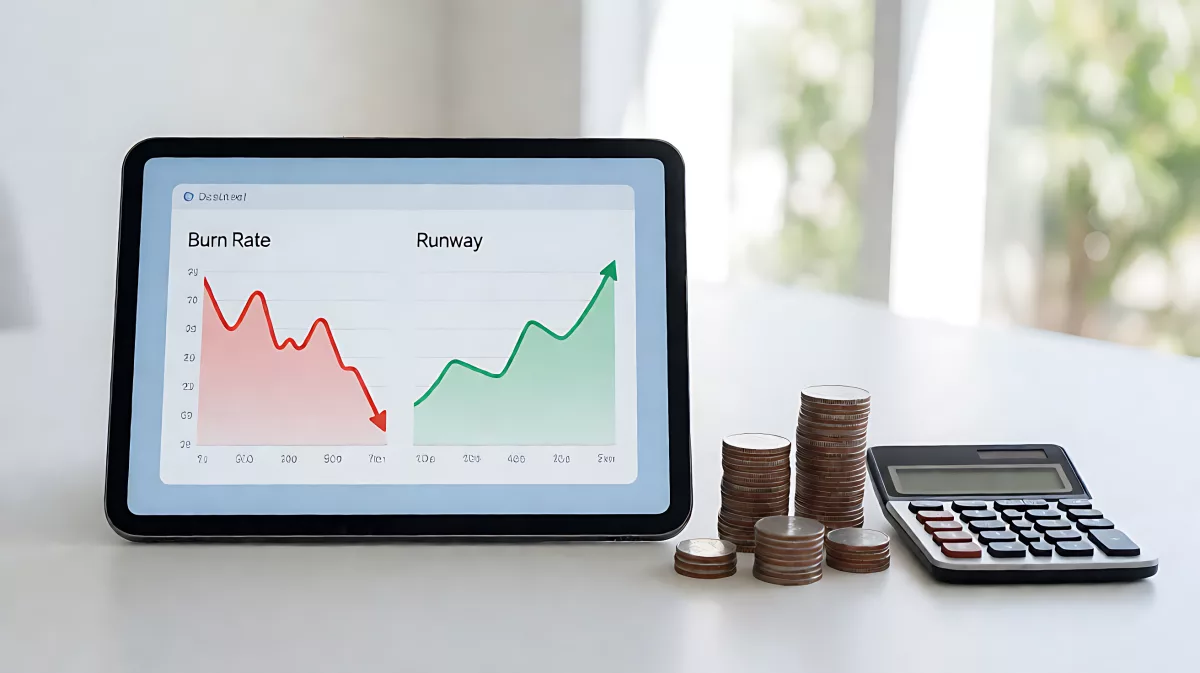
Burn rate measures how fast your cash runs out. Learn the simple formulas to calculate your monthly burn, track your runway, and make smarter spending decisions.
Burn rate is the speed at which your available cash is being spent. For businesses, it measures operating expenses minus revenue. For individuals, it tracks monthly spending against income. A high burn rate shortens your financial runway, while a low one extends it. Monitoring this metric ensures you have enough resources to meet your goals before needing to raise capital or adjust your budget.
What exactly is burn rate in finance?
At its core, burn rate is a metric of cash depletion. It tells you how many dollars, pounds, or euros you are losing per month when you are not yet cash-flow positive. For a startup, this is the money going out the door to cover salaries, rent, and marketing, minus the money coming in from sales. For a household, it is the cost of living minus net income. Understanding this number is the first step toward financial stability because it converts abstract budgeting anxiety into a concrete, trackable statistic.
Financial experts often distinguish between two types of burn. Gross burn rate is the total amount of money spent on operations in a given period, ignoring revenue. Net burn rate is more useful because it accounts for incoming cash. It represents the actual loss for the month. If your gross burn is $10,000 but your revenue is $4,000, your net burn is $6,000. This net figure is what truly impacts your bank account balance.
How do you calculate your personal burn rate?
Calculating your personal burn rate is a straightforward arithmetic exercise that requires only three pieces of data. First, determine your total monthly cash outflows. This includes fixed costs like rent or mortgage, insurance, and subscriptions, as well as variable costs like groceries, dining, and entertainment. Second, determine your total monthly net income. This is your take-home pay after taxes. Third, apply the simple formula:
Net Burn Rate = Total Monthly Expenses - Total Monthly Income
If the result is positive, you have a cash surplus. If the result is negative, that number is your burn rate. For example, if you spend $3,500 per month and earn $2,000 per month, your net burn rate is $1,500. This means you are depleting your savings by $1,500 every month. Over a year, this amounts to $18,000. Knowing this figure allows you to see the long-term impact of your spending habits immediately.
Why does business burn rate matter for investors?
In the venture capital world, burn rate is a critical indicator of efficiency. Investors want to know how much money it costs to generate one dollar in new annual recurring revenue. This metric is known as the burn multiple. A burn multiple of 1x means that for every dollar of net burn, the company is gaining one dollar in new annual recurring revenue. This is considered the gold standard of efficiency. A burn multiple above 2x suggests the company is spending money at a rate that is not being matched by growth, which can alarm potential backer.
According to data from HSBC Innovation Banking, founders who communicate openly about their burn rates build trust with investors. Transparency shows that you understand your unit economics and are a reliable steward of capital. Investors use this data to gauge how long their investment will last. If a company has $1 million in the bank and a net burn rate of $100,000 per month, its runway is ten months. Most founders are advised to start fundraising when they have between nine and twelve months of runway remaining.
How can you manage your burn rate effectively?
Managing burn rate is not just about looking at the number; it is about acting on it. Here are three practical strategies to keep your burn in check:
- Distinguish fixed and variable costs: Fixed costs, like rent and core salaries, are hard to change quickly. Variable costs, like ad spend and freelance contracts, can be reduced almost immediately. When cash flow tightens, cut variable costs first to preserve operations.
- Track quarterly averages: Monthly spending can fluctuate due to seasonal factors. To get a clearer picture of your true burn rate, calculate the average over a three-month period. This smooths out anomalies and gives you a more reliable runway forecast.
- Model revenue scenarios: Treat revenue as a variable in your financial model. Ask yourself: if revenue drops by 20%, how long does my runway last? If revenue grows by 10%, how much does my net burn decrease? This sensitivity analysis helps you prepare for market shifts.
What is the relationship between burn rate and fixed income?
While burn rate is typically associated with businesses and households, the concept applies to retirees and investors managing fixed income portfolios. A 'burn rate' in retirement planning refers to the percentage of your portfolio you withdraw each year to fund your lifestyle. The traditional rule of thumb, often associated with the 4% rule, suggests withdrawing 4% of your portfolio annually. If your actual spending exceeds this rate, you are burning through your principal faster than intended. This increases the risk of depleting your assets before your life expectancy.
For those holding bonds or annuities, understanding the yield versus the burn rate is crucial. If your fixed income payments do not cover your monthly expenses, the difference is the amount you must take from your principal. This is a form of net burn. Monitoring this ensures you know how many years your fixed assets will last under current spending levels. As noted by financial educators, stable but low yields on government bonds mean that high spending burns through the principal quickly, requiring a lower burn rate to maintain solvency.
How long is a healthy runway?
For startups, a healthy runway is generally between 12 and 18 months. This gives you enough time to hit key milestones and raise the next round of funding without panic. For individuals, a healthy financial cushion is six months of expenses in cash. This ensures that if your income stops, you are not burning through savings to cover immediate needs but have a buffer for the long term.
Can burn rate be too low?
In the context of growth companies, yes. Burning too little may mean you are not investing enough in product development or talent to capture market share. While high burn is dangerous for solvency, zero burn can be dangerous for competitiveness. The goal is an efficient burn that aligns with strategic goals, not just a low number.
What tools help track burn rate?
Most accounting software includes burn rate dashboards automatically. For businesses, tools like Wave Financial or QuickBooks can generate these reports from your general ledger. For personal finance, simple spreadsheet templates that categorize monthly expenses versus income can serve as effective trackers. The key is consistency; you must update the data monthly to see real-time changes.
Frequently asked questions
How often should I review my burn rate?
You should review your burn rate at least monthly. Since cash flow can shift due to unexpected expenses or revenue dips, a monthly check-in allows you to spot trends early. Quarterly reviews are also useful for smoothing out seasonal variations and planning larger budget adjustments.
Is there a standard formula for calculating runway?
Yes. Runway is calculated by dividing your current cash balance by your average monthly net burn rate. For instance, if you have $50,000 in cash and your net burn is $5,000 per month, your runway is ten months. This metric tells you exactly how long you can operate before needing to find new capital or cut costs.
Does fixed income have a burn rate?
Not in the traditional corporate sense, but yes in personal finance. For retirees, the 'burn rate' is the annual withdrawal rate from their portfolio. If you spend more than your income, you are burning your principal. Monitoring this percentage is vital to ensure your assets last throughout your lifetime.