Understanding Spending: Government Budgets vs Consumer Habits
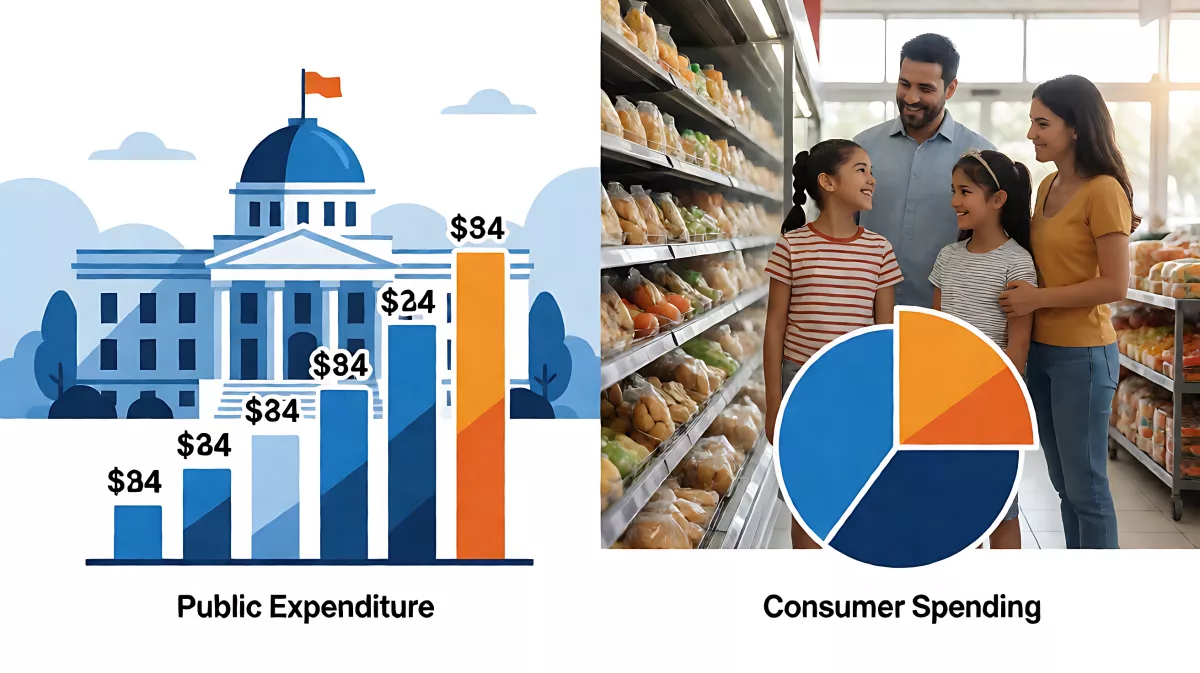
Navigate the complex world of fiscal policy and household budgets. This guide breaks down the difference between how governments allocate the trillions in their spending power and how individual consumers drive the economy.
Government spending in the United States for the fiscal year 2026 is budgeted at $13.33 trillion, combining federal, state, and local expenditures. Consumer spending remains the primary driver of economic activity, with households prioritizing healthcare, housing, and durable goods. The balance between these two forms of expenditure dictates national fiscal policy and household economic health.
What is the difference between government and consumer spending?
Public and private expenditure serve distinct economic functions. Government spending covers the provision of public goods and services, including defense, pensions, and infrastructure. It is a component of Gross Domestic Product (GDP) alongside private investment and net exports. Consumer spending, conversely, represents the total outlay by individuals and households on final goods and services. While governments use fiscal tools to stabilize the business cycle, consumers react to their own income levels and sentiment regarding the economy.
How does the government fund its operations?
Under the assumption of full employment, governments must acquire resources without causing inflation by removing purchasing power from the economy. This is achieved through taxes, borrowing, and the sale of natural resources or fees. For currency-issuing governments, such as those in the US and UK, there is a theoretical limit to nominal spending, but inflation acts as a practical constraint. Non-currency issuing entities, like state or local governments, face stricter revenue limits because they do not control the currency they transact in.
What are the key canons of public expenditure?
Economist George Findlay Shirras outlined four primary canons to guide government spending policy. The Canon of Benefit suggests that spending must maximize social welfare. The Canon of Economy insists on productive efficiency rather than miserliness. The Canon of Sanction requires that spending be authorized by appropriate bodies. Finally, the Canon of Surplus argues that revenue should ideally exceed expenditure to avoid deficits, though modern fiscal policy often balances this with the need for economic stimulus.
How much does the US government spend in FY 2026?
According to data from the US Department of the Treasury and the Census Bureau, the federal government is budgeted to spend $7.54 trillion in fiscal year 2026. When combined with state and local spending, total public expenditure reaches $13.33 trillion. Interest payments have become a major category, accounting for nearly $1.1 trillion of the total, reflecting the high cost of servicing the national debt. The gross federal debt is projected to reach $39.04 trillion by the end of FY 2026, up from $37.37 trillion in the prior year.
| Spending Category | FY 2026 Estimate ($ Trillion) |
|---|---|
| Federal Spending | 7.54 |
| State Spending | 3.62 |
| Local Spending | 3.41 |
| Total Public Spending | 13.33 |
Where does the federal budget go?
Public expenditure is broadly categorized into consumption and capital formation. In FY 2026, the budget allocates significant funds to mandatory entitlements such as Social Security and healthcare. Defense spending is also a substantial line item, with the Pentagon and veterans' services consuming over $1.4 trillion. This reflects the dual role of government in maintaining security and providing social safety nets for the population.
What drives consumer spending habits?
Consumer behavior is a mixture of induced consumption, which relies on income levels, and autonomous consumption, which remains constant regardless of income changes. In the US, consumer spending has historically made up roughly 70% of GDP. The Bureau of Economic Analysis tracks this through three main categories: durable goods (like vehicles and appliances), nondurable goods (like food and clothing), and services (like healthcare and housing).
How does sentiment impact the economy?
Consumer sentiment is a powerful predictor of economic activity. When households are optimistic about job security and market stability, they are more likely to spend and invest. Conversely, during periods of uncertainty, individuals may save aggressively even if they receive government stimulus packages like tax rebates. This psychological factor means that fiscal policy can only be effective if it successfully alters public confidence.
What role do taxes play in spending?
Tax policy directly adjusts the amount of disposable income available for consumer spending. Under the GDP equation (GDP = C + I + G + NX), increases in government spending (G) are often funded by tax increases or deficit spending, which can potentially crowd out private consumption (C). However, when tax cuts are timed well, they can stimulate the economy by increasing C and I, leading to broader economic expansion.
Frequently Asked Questions
What is the difference between federal and state spending?
Federal spending includes national programs like defense, Social Security, and Medicare. State and local spending focuses on education, transportation infrastructure, and public safety within their jurisdictions. In FY 2026, federal spending is budgeted at $7.54 trillion, while state and local combined spending is estimated at $7.03 trillion.
Why is the US national debt increasing?
The debt increases when government outlays exceed tax revenue, a situation known as a deficit. The budgeted deficit for FY 2026 is $2.06 trillion. As the interest rates on existing debt rise, the cost of servicing the debt grows, further widening the gap between revenue and spending.
How do consumers decide what to buy?
Consumers weigh their current income against their financial goals and economic outlook. Factors like inflation, employment rates, and interest rates on credit cards and mortgages influence whether households prioritize saving, investing, or purchasing consumer goods and services.