Why You Should Avoid Scheduling Meetings Right After Lunch
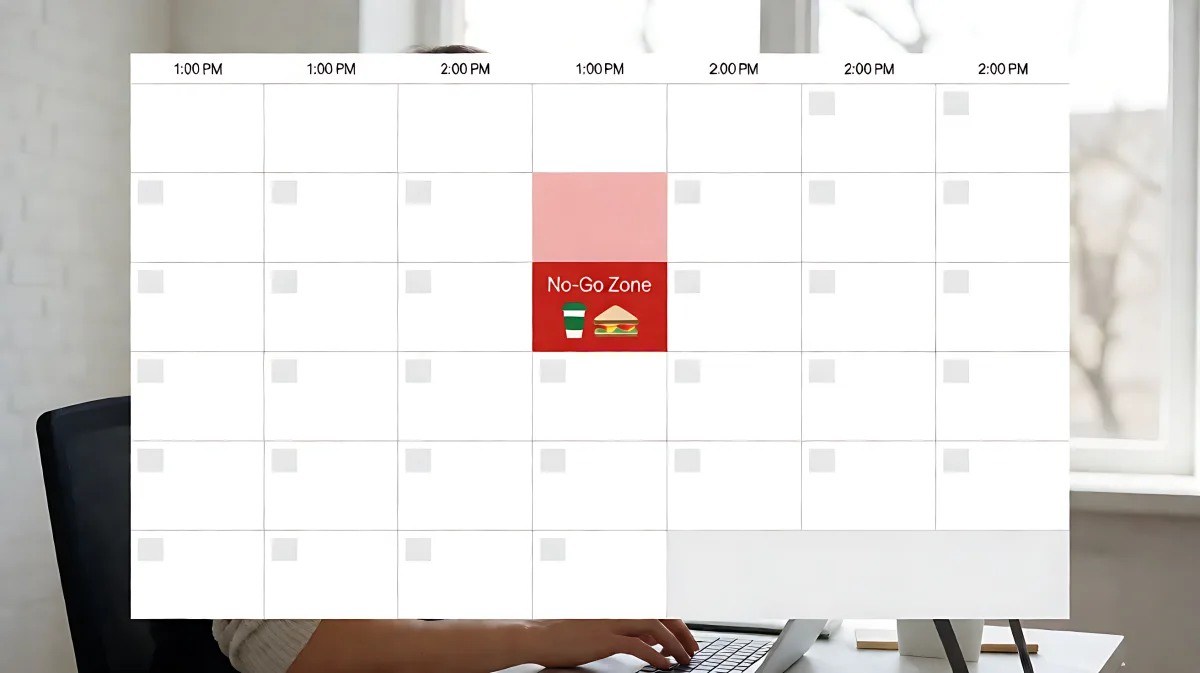
Scheduling a meeting for 1:00 PM often results in skipped lunch and poor focus. Use this guide to calculate your usable gap time and protect your midday break.
Many professionals assume that the hour after lunch is prime time for back-to-back meetings, but in fact, it is often the most cognitively fragile part of the day. Scheduling critical appointments during this window typically forces employees to skip or rush their midday meal, leading to measurable drops in reaction time and decision-making ability. To avoid this, you must calculate your appointment gap not just as raw time, but as usable time, ensuring you have a genuine buffer for rest and refueling before your next commitment.
Why the 1:00 PM Meeting Undermines Performance
The human body undergoes a natural circadian dip in the early afternoon, a biological tendency toward lower alertness. When you layer a 1:00 PM meeting on top of this, the physiological impact is compounded by the fact that most people have not yet eaten their midday meal. Research in chrononutrition suggests that maintaining a consistent eating rhythm is crucial for metabolic health and energy stability. If a meeting forces you to delay eating until 3:00 PM, your blood glucose levels may dip, resulting in what experts call a 'vicious cycle' of caffeine dependency and fatigue.
According to data cited by workplace wellness experts, a significant portion of employees report that back-to-back meetings leave them no time to eat properly. One frequently referenced statistic from industry surveys indicates that over half of workers have skipped lunch due to scheduling conflicts. This is not merely a comfort issue; it is a performance issue. Studies published in journals such as Physiology & Behavior have demonstrated that caloric restriction or skipped meals significantly reduce concentration and problem-solving skills. When you attend a 1:00 PM meeting on an empty stomach, you are effectively asking your brain to perform high-level cognitive tasks with reduced fuel.
What Is the Cost of Skipping Lunch for a Meeting?
The cost is twofold: immediate cognitive decline and long-term health risks. Caffeine consumption on an empty stomach, often a crutch for the post-meeting energy crash, can increase acid production and lead to gastrointestinal discomfort. Furthermore, caffeine consumed after 1:00 PM has been linked to sleep disruption even when taken six hours before bedtime. This means that the 'quick fix' of a coffee to get through the 1:00 PM meeting can rob you of quality sleep that night, leading to greater fatigue the following morning. The decision to schedule an appointment at this time rarely accounts for this lagging effect on your next 24 hours.
How to Calculate Your True Appointment Gap
Most calendars display appointments in static blocks, but they do not account for the transition time required to be mentally and physically prepared for the next task. A raw gap of 45 minutes between two meetings is not 45 minutes of usable time. You must subtract a transition buffer. This buffer covers the time needed to stand up, walk to the next location, log out of one system, log into another, hydrate, and mentally switch contexts.
To determine if you have enough free time, use this simple formula:
Usable Gap = Raw Gap – Transition Buffer
For example, if Appointment A ends at 12:45 PM and Appointment B starts at 1:30 PM, the raw gap is 45 minutes. If your personal transition buffer is 15 minutes (time to get coffee, clear your desk, and set up for the next call), your usable gap is only 30 minutes. If you intended to eat lunch in that 30 minutes, it is likely unrealistic. Most people need at least 20 to 30 minutes to eat a meal without stress. Therefore, if you cannot secure that time before the 1:00 PM slot, the lunch is at risk.
How Do You Define a Minimum Useful Gap?
A minimum useful gap is the shortest duration of free time you can actually use for a specific activity. There is no universal standard, but here are practical benchmarks for most office workers:
- 15 Minutes: Sufficient for a quick bathroom break, a cup of water, or a brief stretch.
- 30 Minutes: The minimum for a proper sit-down lunch or a substantial administrative task.
- 45-60 Minutes: Required for deep work, focused coding or writing, or a restorative nap.
If the gap between your appointments is less than your minimum useful gap for the activity you wish to perform, that time is effectively lost. It becomes 'dead time' filled with anxious scrolling or low-value email triage rather than genuine rest or productive work.
Strategic Checklist for Better Midday Scheduling
Before you accept any meeting invitation for the 1:00 PM to 2:00 PM window, run through this checklist. This process helps you move from passive scheduling to active time management.
- Check the Pre-Meeting Gap: Look at your calendar for the hour before the meeting. If you have back-to-back calls until 12:50 PM, you have no time to eat. Decline or move the meeting.
- Calculate Your Buffer: Add 10 to 15 minutes to the gap between your last morning task and the 1:00 PM meeting. If the result is less than 20 minutes, you are likely to skip lunch.
- Identify the Nature of the Meeting: Is this a creative brainstorming session? If so, it is a poor fit for the post-lunch dip. Save those for late morning or early afternoon (after 2:00 PM).
- Use 'No-Go' Zones: Block out 1:00 PM to 2:00 PM on your calendar as 'Lunch & Focus Time' by default. Only unblock it for emergencies. This sends a signal to colleagues that you value your midday break.
- Automate Slot Generation: If you manage a team or run a business, use time slot generators to set buffer times automatically. For example, a clinic might use 20-minute slots with a 10-minute buffer. Translating this to office work, ensure your calendar tools add a 5-10 minute break between meetings automatically.
Common Mistake: Assuming You Can Work While Eating
A pervasive misconception is that you can effectively 'multitask' by eating a quick lunch while listening to a podcast or answering emails. In fact, this prevents your digestive system from entering the relaxed state it needs for efficient nutrient absorption. It also keeps your brain in a state of constant low-grade alertness, preventing the reset that a true break provides. True recovery requires a brief period of disengagement from work stimuli. If you schedule a 1:00 PM meeting that leaves you with only 10 minutes to eat, you will likely eat at your desk, distracted, and gain none of the cognitive benefits of the break.
How to Reclaim Your Afternoon Productivity
Once you have protected your 1:00 PM lunch, the rest of your afternoon can feel less chaotic. By ensuring you have eaten and rested, you align with your body's natural rhythms rather than fighting them. This approach is not just about comfort; it is about sustainability. Organizations that encourage structured breaks report lower rates of burnout and higher employee satisfaction.
Consider the alternative: a schedule where 1:00 PM is a blackout zone for meetings. You use that time to eat, walk outside, and reset. Then, when the 2:00 PM meeting begins, you are fueled, hydrated, and mentally fresh. The quality of your contribution will be higher, and the meeting will likely end earlier because you are not fighting through post-lunch fog.
What If My Job Requires High Availability?
Even in high-pressure roles, you must negotiate your breaks. If you are in a role where you are always on call, you need to be even more disciplined about protecting the post-lunch window, as the risk of fatigue accumulation is higher. Use the 'Minimum Useful Gap' concept to defend your time. If the gap is too small for a real break, argue that the quality of your work will suffer, costing the company more in errors than a 30-minute pause saves.
Frequently Asked Questions
Is it really that bad to skip lunch for a meeting?
Yes. Skipping lunch can lead to low blood sugar, which impairs cognitive function, reduces reaction time, and increases irritability. It also often leads to overeating later in the day due to the 'rebound' effect, which can cause a further energy crash in the evening.
How long should a transition buffer be between meetings?
A standard transition buffer is 5 to 10 minutes. This allows time to stand up, use the restroom, change rooms or call IDs, and mentally prepare for the next agenda. If you are traveling between locations, the buffer must be significantly longer to account for travel time.
Can I use a calculator to plan my entire week?
Yes. You can use time slot generators and appointment gap calculators to review your weekly schedule. Look for patterns where you have three or more 'dead zones' (gaps too small for work, too large for rest). Consolidate these by grouping similar tasks or extending your lunch break to cover the fragmented time.
What is the best time of day for deep work?
For most people, the late morning (10:00 AM to 12:00 PM) is the peak cognitive window. The early afternoon, after a proper lunch break, is the second-best window. The period between 1:00 PM and 2:00 PM is typically the lowest energy point of the day, making it ideal for administrative tasks or breaks, not deep creative work.
Does the time zone difference matter for my appointment gap?
Only if you are collaborating with teams in different time zones. If your local time is 1:00 PM but your counterpart's local time is 10:00 AM, the dynamic changes. You are in your low-energy window, while they are in their high-energy window. Be aware of this asymmetry and use it to structure the meeting so that your local afternoon is reserved for tasks that do not require peak cognitive effort from you.